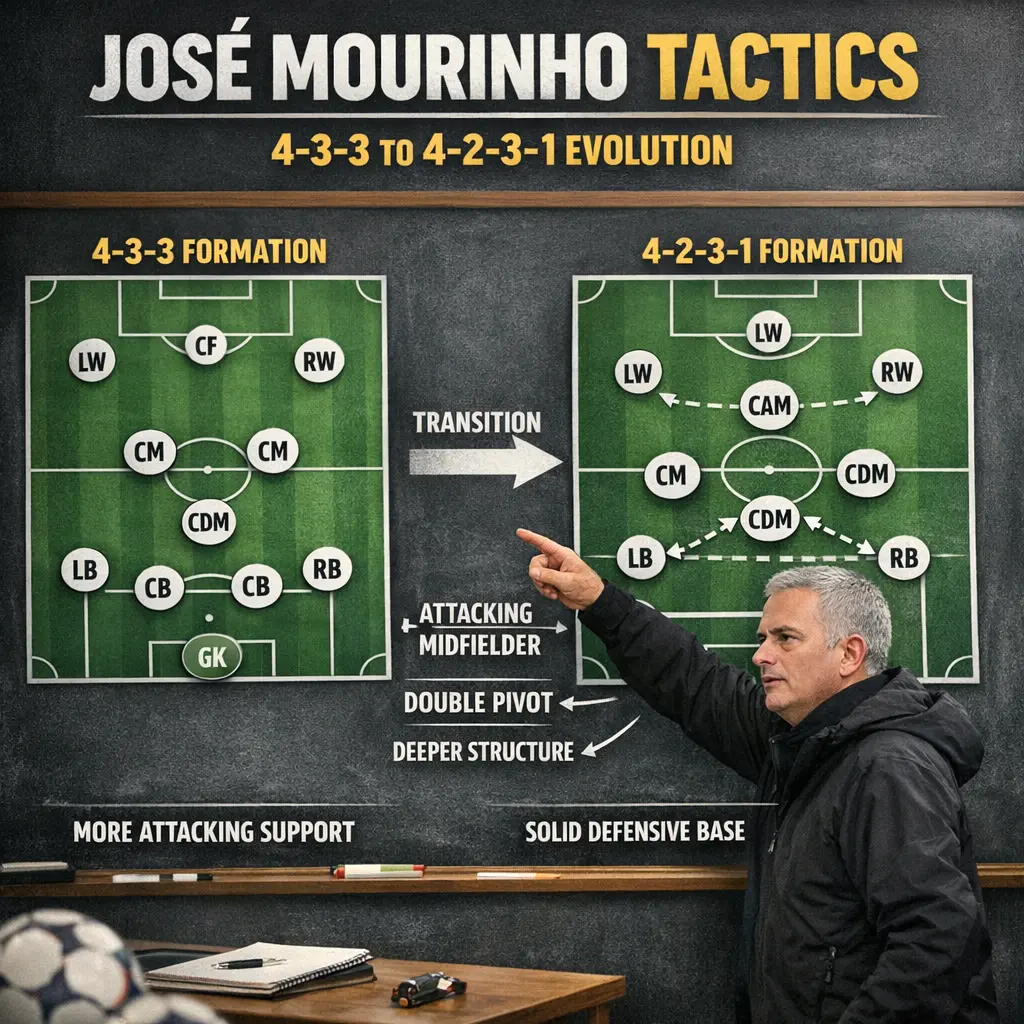
Jose Mourinho’s tactical evolution at Chelsea saw a shift from a balanced 4-3-3, emphasizing midfield solidity and quick transitions, to a more attacking 4-2-3-1. Initially, the 4-3-3 provided defensive stability, with Makelele anchoring midfield. Over time, Mourinho adopted 4-2-3-1, granting more creative freedom to attacking players like Hazard and Oscar, while still maintaining defensive discipline with two holding midfielders, enhancing Chelsea’s offensive threat.
Jose Mourinho Tactics: 4-3-3 to 4-2-3-1 Evolution
Jose Mourinho’s tactical evolution at Chelsea saw a shift from a balanced 4-3-3, emphasizing midfield solidity and quick transitions, to a more attacking 4-2-3-1. Initially, the 4-3-3 provided defensive stability, with Makelele anchoring midfield. Over time, Mourinho adopted 4-2-3-1, granting more creative freedom to attacking players like Hazard and Oscar, while still maintaining defensive discipline with two holding midfielders, enhancing Chelsea’s offensive threat.
💡 Key Takeaways
- Understand the strategic reasons behind Mourinho's shift from a 4-3-3 to a 4-2-3-1 and what it changed in midfield control.
- Learn the roles of the double pivot, the number 10 in front of them, and the wide players in the 4-2-3-1 compared with the 4-3-3 setup.
- See how the formation changes influence pressing triggers, defensive organization, and quick transitions from defense to attack.
- Recognize the trade-offs of each system and how player selection and opposition shape Mourinho's tactical evolution.
❓ Frequently Asked Questions
What is the 4-3-3 formation in Mourinho's tactics?
Four defenders, three midfielders, and three forwards. The midfield trio balances defense and attack, with pressing and quick transitions as key ideas.
What is the 4-2-3-1 formation and how does it differ from 4-3-3?
Four defenders, two defensive midfielders, and three attackers behind a lone striker. It offers greater defensive solidity and a dedicated playmaker behind the striker.
How does Mourinho transition from 4-3-3 to 4-2-3-1?
Add a second holding midfielder to shield the back line, move a midfielder into a number 10 role, and use fullbacks to support width, shifting balance toward midfield control.
What are the key roles in a Mourinho-style 4-2-3-1?
Defensive midfielder as the pivot; central attacking midfielder behind the striker; three attackers ahead; fullbacks providing width; and the striker as the focal point.