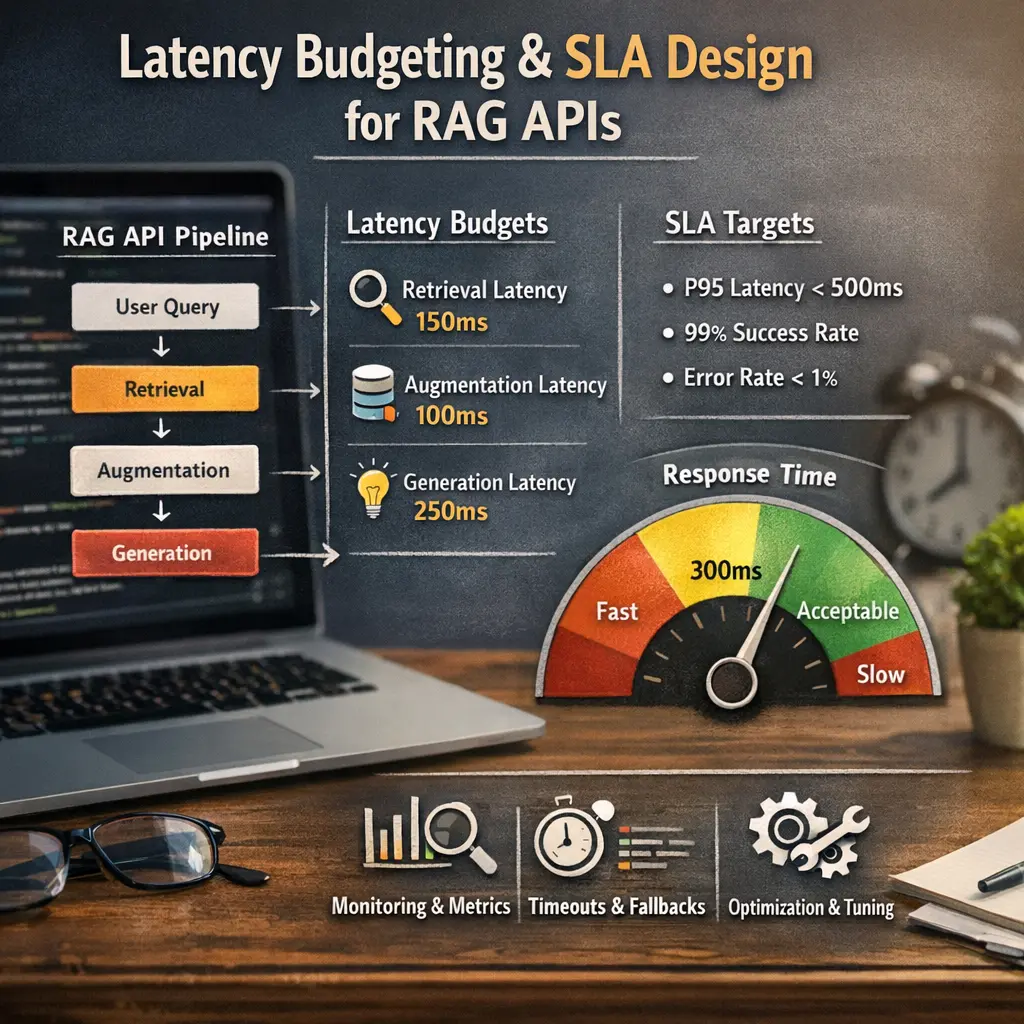
Latency budgeting and SLA design for RAG APIs involves systematically allocating permissible response times across each component of a Retrieval-Augmented Generation pipeline to ensure that the overall system meets agreed-upon Service Level Agreements (SLAs). This process requires understanding the latency contributions of retrieval, generation, and orchestration steps, then setting performance targets and monitoring mechanisms. Effective latency budgeting helps maintain user experience, reliability, and compliance with contractual obligations in production RAG applications.
Latency Budgeting and SLA Design for RAG APIs
Latency budgeting and SLA design for RAG APIs involves systematically allocating permissible response times across each component of a Retrieval-Augmented Generation pipeline to ensure that the overall system meets agreed-upon Service Level Agreements (SLAs). This process requires understanding the latency contributions of retrieval, generation, and orchestration steps, then setting performance targets and monitoring mechanisms. Effective latency budgeting helps maintain user experience, reliability, and compliance with contractual obligations in production RAG applications.
💡 Key Takeaways
- Define a latency budget for a RAG API and split it across retrieval, generation, and orchestration.
- Design SLAs that specify end-to-end latency targets (e.g., p95/p99), uptime, and error tolerance for RAG APIs.
- Identify and measure the main latency contributors in a RAG pipeline: vector search, model inference, and data fetching.
- Implement strategies to meet budgets: caching, batching, asynchronous calls, and model/infra optimizations.
❓ Frequently Asked Questions
What is latency budgeting in the context of RAG APIs?
Latency budgeting is setting an end-to-end time target for a request and distributing it across components (retrieval, generation, network) so the total stays within the target, ensuring a predictable user experience.
What is an SLA for RAG APIs and what should it include?
An SLA is a formal agreement that defines expected performance, including end-to-end latency targets, availability, error rate, and throughput. For RAG APIs, it should address retrieval latency, generation latency, and end-to-end bounds.
How should you design SLAs for RAG pipelines with retrieval and generation stages?
Define end-to-end latency budgets, specify separate targets for retrieval and generation, set tail-latency limits (e.g., P95/P99), outline degradation modes and fallbacks, and establish monitoring and escalation processes.
What techniques help reduce latency and improve SLA compliance in RAG APIs?
Use indexing and caching for retrieval, batch and parallelize retrieval, employ asynchronous or streaming generation, optimize prompts and model size, use approximate nearest neighbor search, model quantization, hardware acceleration, and network optimizations.