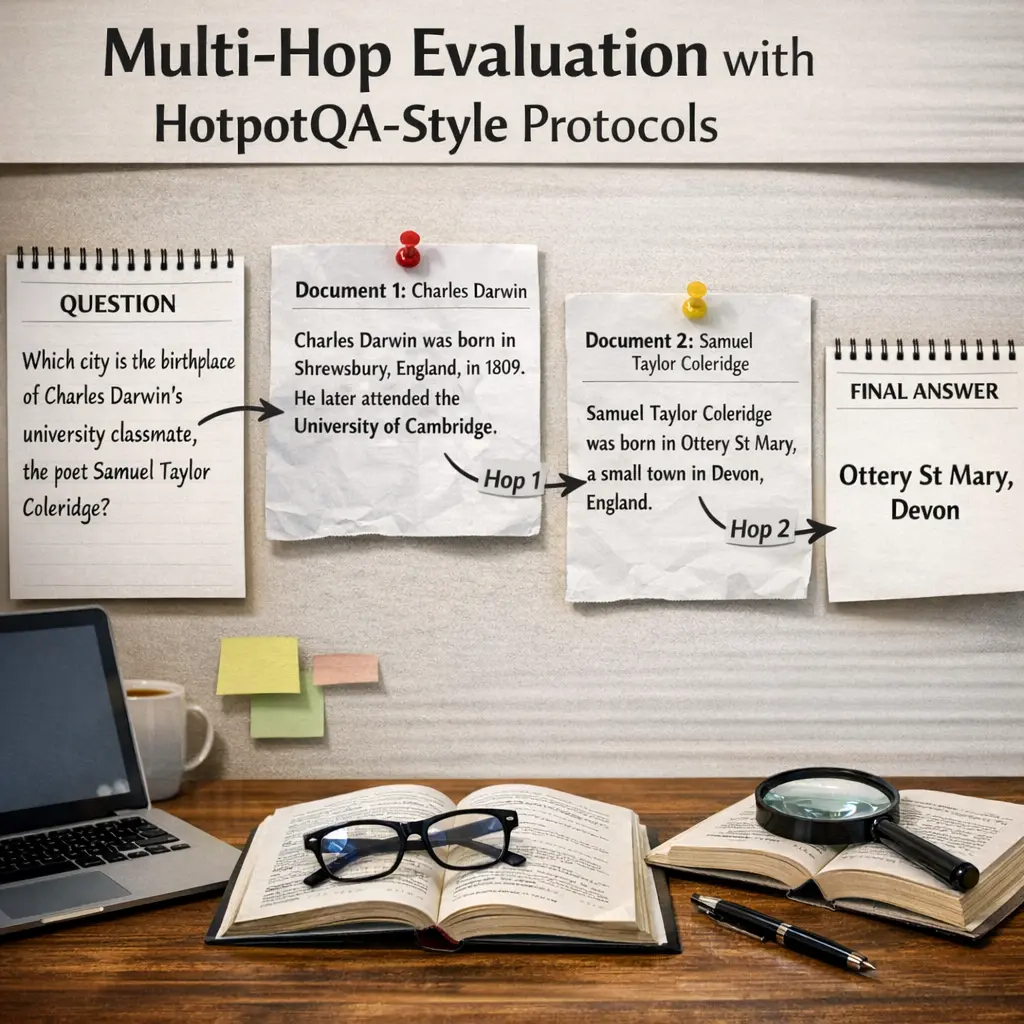
Multi-Hop Evaluation with HotpotQA-Style Protocols (Advanced RAG Techniques) refers to assessing retrieval-augmented generation (RAG) systems using evaluation setups inspired by HotpotQA, a benchmark requiring models to answer questions by synthesizing information from multiple documents or passages. This approach tests a model’s ability to perform complex, multi-step reasoning across different knowledge sources, ensuring it can retrieve, integrate, and reason over disparate pieces of evidence to generate accurate, contextually rich answers.
Multi-Hop Evaluation with HotpotQA-Style Protocols
Multi-Hop Evaluation with HotpotQA-Style Protocols (Advanced RAG Techniques) refers to assessing retrieval-augmented generation (RAG) systems using evaluation setups inspired by HotpotQA, a benchmark requiring models to answer questions by synthesizing information from multiple documents or passages. This approach tests a model’s ability to perform complex, multi-step reasoning across different knowledge sources, ensuring it can retrieve, integrate, and reason over disparate pieces of evidence to generate accurate, contextually rich answers.
💡 Key Takeaways
- Understand what multi-hop evaluation means and why reasoning across multiple sources is required for accurate answers
- Learn the structure of HotpotQA-style protocols: questions, multiple supporting facts, and explicit reasoning chains
- Familiarize yourself with evaluation metrics and error analysis used in multi-hop QA (e.g., exact match, F1, and evidence accuracy)
- Apply best practices for building and validating multi-hop questions, including evidence retrieval and chain-of-thought reasoning checks
❓ Frequently Asked Questions
What does multi-hop evaluation mean in QA tasks?
It means solving questions by chaining information from multiple sources or steps, not relying on a single fact.
What is a HotpotQA-style protocol?
A QA setup where questions require reasoning across several documents; models must produce the final answer and identify supporting facts that justify it.
What are 'supporting facts'?
Specific sentences or passages that provide evidence for the answer; in HotpotQA-style tasks, you typically identify them as part of the evaluation.
How is performance measured in this style of QA?
By how accurately the answer is produced (e.g., exact match or F1) and how well the model selects supporting facts (precision/recall or F1 against gold evidence).
What are common challenges in multi-hop QA?
Locating relevant information across multiple sources, avoiding distractors, and ensuring a coherent reasoning chain to justify the final answer.