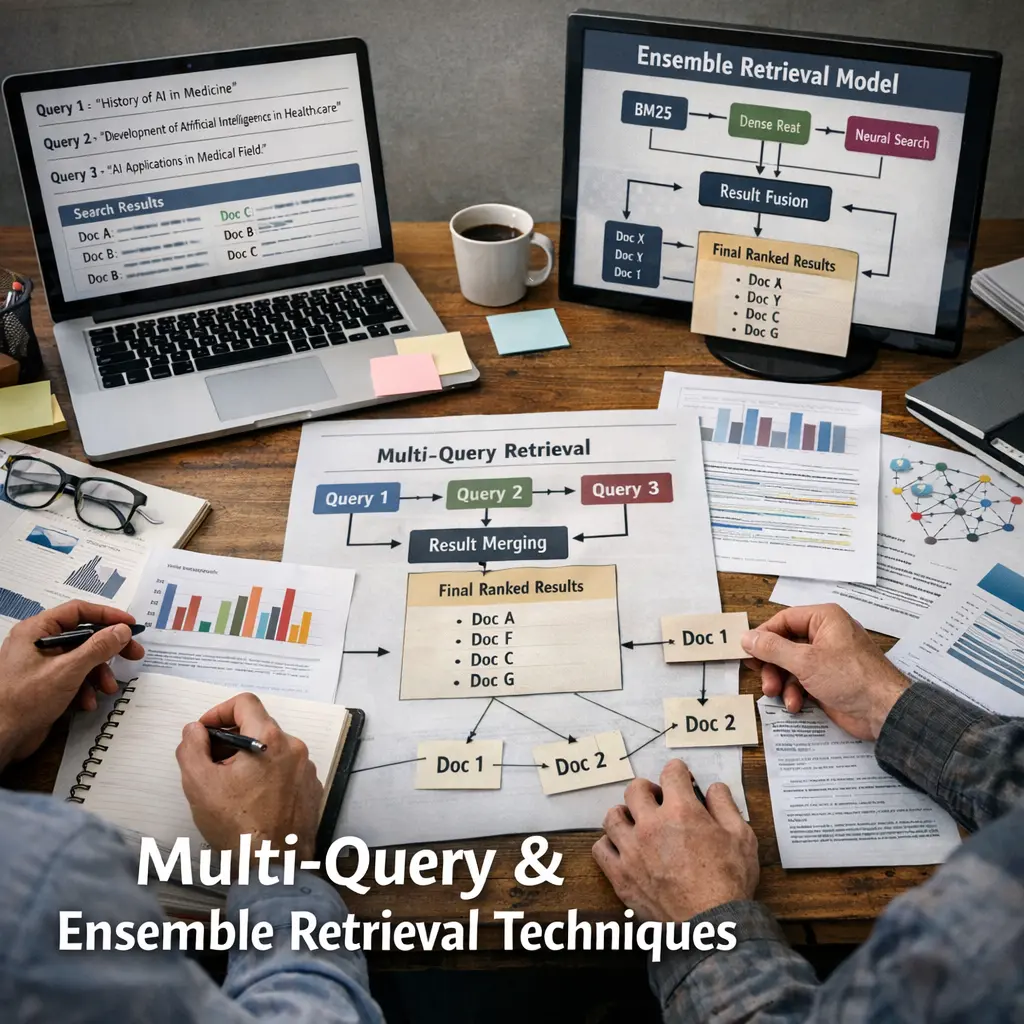
Multi-Query and Ensemble Retrieval Techniques in Retrieval-Augmented Generation (RAG) involve using multiple queries or diverse retrieval models to fetch relevant information from large datasets. By combining results from various queries or retrieval systems, these techniques enhance the diversity and accuracy of retrieved knowledge. This enriched context is then provided to generative models, improving the quality and relevance of generated responses in tasks like question answering or summarization.
Multi-Query and Ensemble Retrieval Techniques
Multi-Query and Ensemble Retrieval Techniques in Retrieval-Augmented Generation (RAG) involve using multiple queries or diverse retrieval models to fetch relevant information from large datasets. By combining results from various queries or retrieval systems, these techniques enhance the diversity and accuracy of retrieved knowledge. This enriched context is then provided to generative models, improving the quality and relevance of generated responses in tasks like question answering or summarization.
💡 Key Takeaways
- Explain what multi-query retrieval is and how expanding a user query can improve recall.
- Describe ensemble retrieval and how combining multiple models or representations can boost robustness and accuracy.
- Compare common fusion methods used to merge results from multiple sources, such as score averaging or rank fusion.
- Identify practical trade-offs and considerations, including latency, compute cost, and potential query drift when using multi-query and ensemble techniques.
❓ Frequently Asked Questions
What is multi-query retrieval?
A retrieval approach that uses multiple query variants to search the index and then combines the results, improving recall and covering different user intents.
What is ensemble retrieval?
A strategy that combines results from multiple retrieval models or systems to boost overall effectiveness, using methods like score fusion or learning-to-rank.
How do multi-query and ensemble retrieval differ?
Multi-query focuses on generating several query variants to diversify results, while ensemble retrieval fuses outputs from different models; they can be used together.
What are common fusion strategies in ensemble retrieval?
Score averaging, rank fusion (e.g., max or union), reciprocal rank fusion, and learning-to-rank or neural fusion techniques.
What are typical trade-offs when using these techniques?
Higher computational cost and potential noise from non-relevant variants, requiring careful calibration and evaluation.