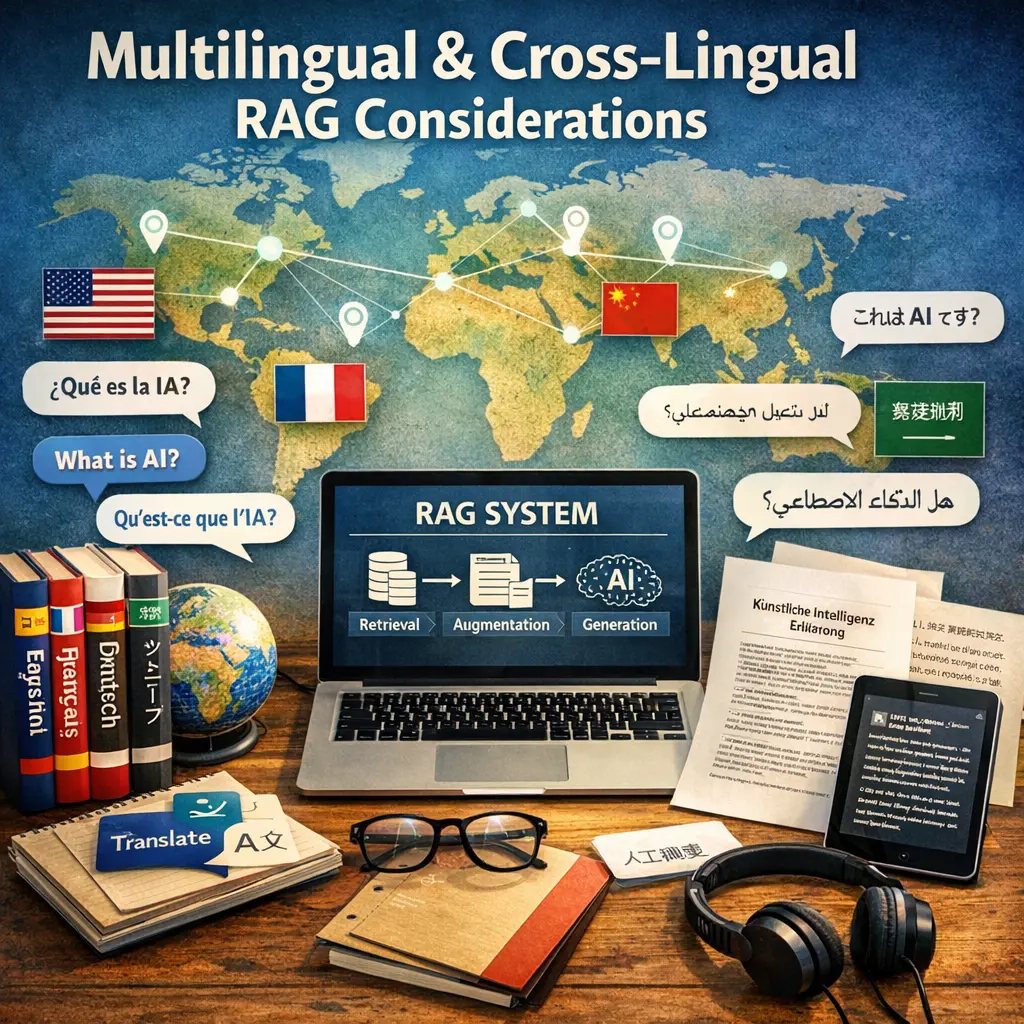
Multilingual and Cross-Lingual RAG considerations involve adapting Retrieval-Augmented Generation systems to handle multiple languages or enable information retrieval and generation across different languages. Key aspects include ensuring high-quality translation, handling language-specific nuances, aligning retrievers and generators across languages, and maintaining retrieval accuracy. These considerations address challenges like diverse linguistic structures, resource availability, and cross-lingual semantic understanding, ultimately aiming to provide accurate, contextually relevant responses regardless of the user's language.
Multilingual and Cross-Lingual RAG Considerations
Multilingual and Cross-Lingual RAG considerations involve adapting Retrieval-Augmented Generation systems to handle multiple languages or enable information retrieval and generation across different languages. Key aspects include ensuring high-quality translation, handling language-specific nuances, aligning retrievers and generators across languages, and maintaining retrieval accuracy. These considerations address challenges like diverse linguistic structures, resource availability, and cross-lingual semantic understanding, ultimately aiming to provide accurate, contextually relevant responses regardless of the user's language.
💡 Key Takeaways
- Understand how retrieval-augmented generation (RAG) operates in multilingual and cross-lingual contexts.
- Learn how cross-lingual embeddings and translation influence retrieval performance and language coverage.
- Identify challenges such as data availability, translation quality, and bias considerations in multilingual RAG.
- Compare strategies for translation-first versus native multilingual retrieval and know when to apply each.
❓ Frequently Asked Questions
What is Retrieval-Augmented Generation (RAG) and how does multilingual RAG differ?
RAG combines a retriever with a generator to fetch relevant documents and generate answers. Multilingual RAG extends this to multiple languages using multilingual embeddings and corpora so retrieval and response generation can occur across languages.
What is cross-lingual retrieval and what challenges does it present?
Cross-lingual retrieval fetches documents in one language using a query in another. Challenges include uneven language coverage, translation noise, and gaps in aligning semantics across languages.
How should you evaluate a multilingual/cross-lingual RAG system?
Evaluate retrieval quality (recall, precision@k) and generation quality in the target language (fluency, relevance, factuality). Use multilingual benchmarks and consider human judgments for cross-language accuracy.
What are best practices for building multilingual RAG systems?
Use strong multilingual encoders and aligned embeddings, ensure diverse language coverage, minimize unreliable translation steps when possible, and monitor for hallucinations with language-aware evaluation.