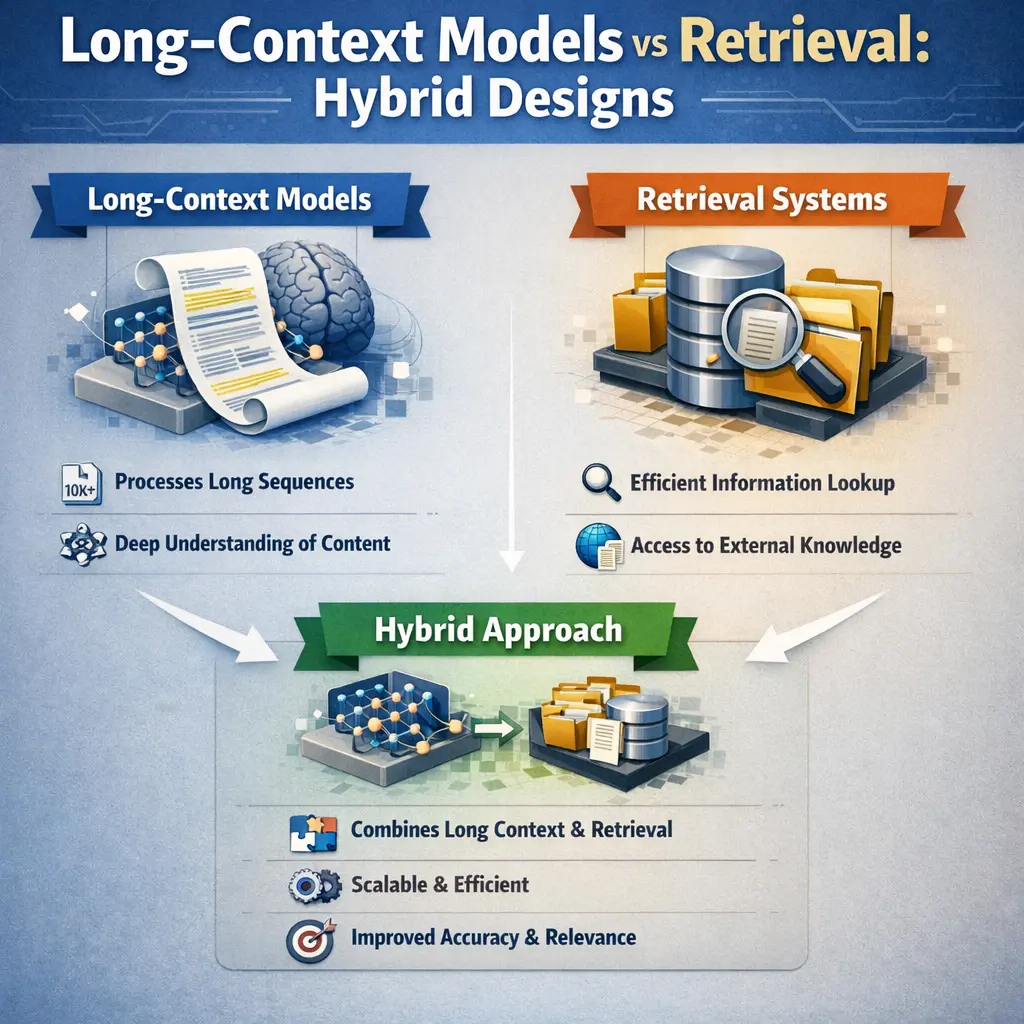
Neural Indexes and Token-Free Retrieval are advanced Retrieval-Augmented Generation (RAG) techniques that leverage neural network-based representations instead of traditional keyword or token-based methods. Neural indexes encode data into dense vectors, enabling more semantic and context-aware search. Token-free retrieval further removes dependency on discrete tokens, allowing models to retrieve and understand information based on meaning rather than exact word matches, resulting in more accurate and flexible information retrieval in AI systems.
Neural Indexes and Token-Free Retrieval
Neural Indexes and Token-Free Retrieval are advanced Retrieval-Augmented Generation (RAG) techniques that leverage neural network-based representations instead of traditional keyword or token-based methods. Neural indexes encode data into dense vectors, enabling more semantic and context-aware search. Token-free retrieval further removes dependency on discrete tokens, allowing models to retrieve and understand information based on meaning rather than exact word matches, resulting in more accurate and flexible information retrieval in AI systems.
💡 Key Takeaways
- Understand how neural indexes transform text into dense vector representations for retrieval.
- Learn what token-free retrieval is and how it differs from conventional keyword-based search.
- See how vector similarity search enables fast neural retrieval at scale.
- Identify practical trade-offs and considerations for neural index-based retrieval, including model quality, indexing updates, memory, and latency.
❓ Frequently Asked Questions
What is a neural index?
A data structure that stores neural embeddings of documents to enable fast semantic search, matching meaning rather than exact words.
What is token-free retrieval?
Retrieval that uses continuous vector representations instead of discrete tokens, allowing queries and documents to be matched by meaning without relying on keyword indices.
How do neural indexes work in practice?
Each document is encoded into a vector; vectors are stored in a vector index (e.g., FAISS, HNSW). A query is encoded into a vector and the nearest neighbors are retrieved by a similarity metric.
What are the advantages and limitations of token-free retrieval?
Advantages: stronger semantic matching, robustness to synonyms, good for large, diverse corpora. Limitations: requires good encoders, can be computationally intensive, may struggle with precise term matching and updates.