Observability: Tracing, Metrics, and Logging for RAG
💡 Key Takeaways
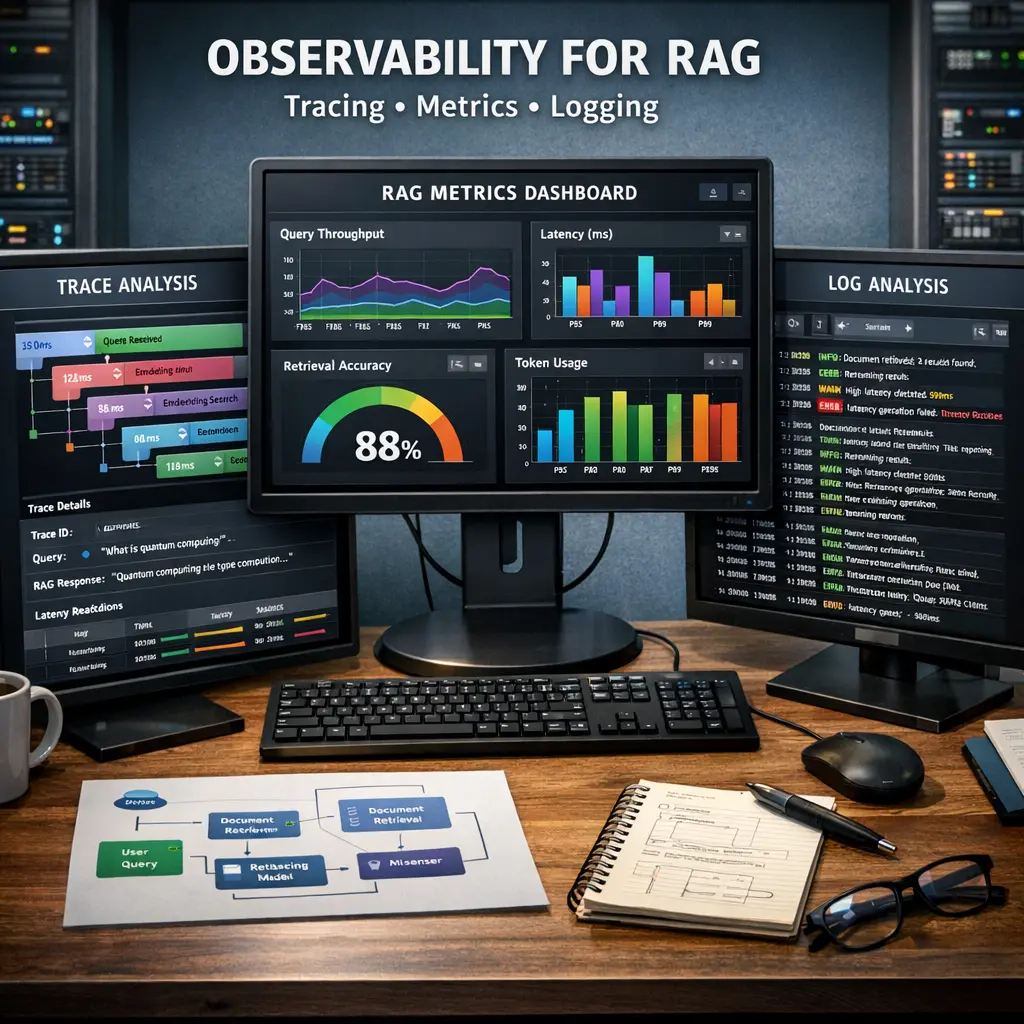
- Understand how tracing, metrics, and logging contribute to observability in Retrieval-Augmented Generation (RAG) systems.
- Learn how tracing identifies bottlenecks and errors across retrieval, augmentation, and generation steps.
- Identify key metrics for RAG, including latency, throughput, retrieval accuracy, and end-to-end response time.
- Apply best practices for logging in RAG, capturing requests, prompts, responses, and audit trails for debugging and compliance.
❓ Frequently Asked Questions
What is observability, and how does it apply to Retrieval-Augmented Generation (RAG) pipelines?
Observability is the ability to understand internal behavior from external signals. In RAG, it means tracing requests across retrieval, augmentation, and generation, and collecting metrics and logs to diagnose performance and quality issues.
What are the three pillars of observability, and what does each provide in a RAG system?
Tracing: the end-to-end flow and latency across components. Metrics: numerical measurements like latency, throughput, and error rate. Logging: detailed events and messages for debugging and auditing.
How does tracing help identify bottlenecks in a RAG pipeline?
Tracing records spans for each stage (retrieval, augmentation, generation) and shows per-stage latency and failures, helping locate slow or problematic components.
Which metrics are important to monitor in a RAG system, and why?
End-to-end and per-stage latency, throughput, error rate, and resource usage (CPU/memory). These metrics reveal performance, reliability, and capacity trends across the pipeline.
What is the difference between logging, metrics, and tracing?
Logging captures individual events and messages; metrics summarize state with numbers; tracing links related events into a single request journey to show flow and latency.