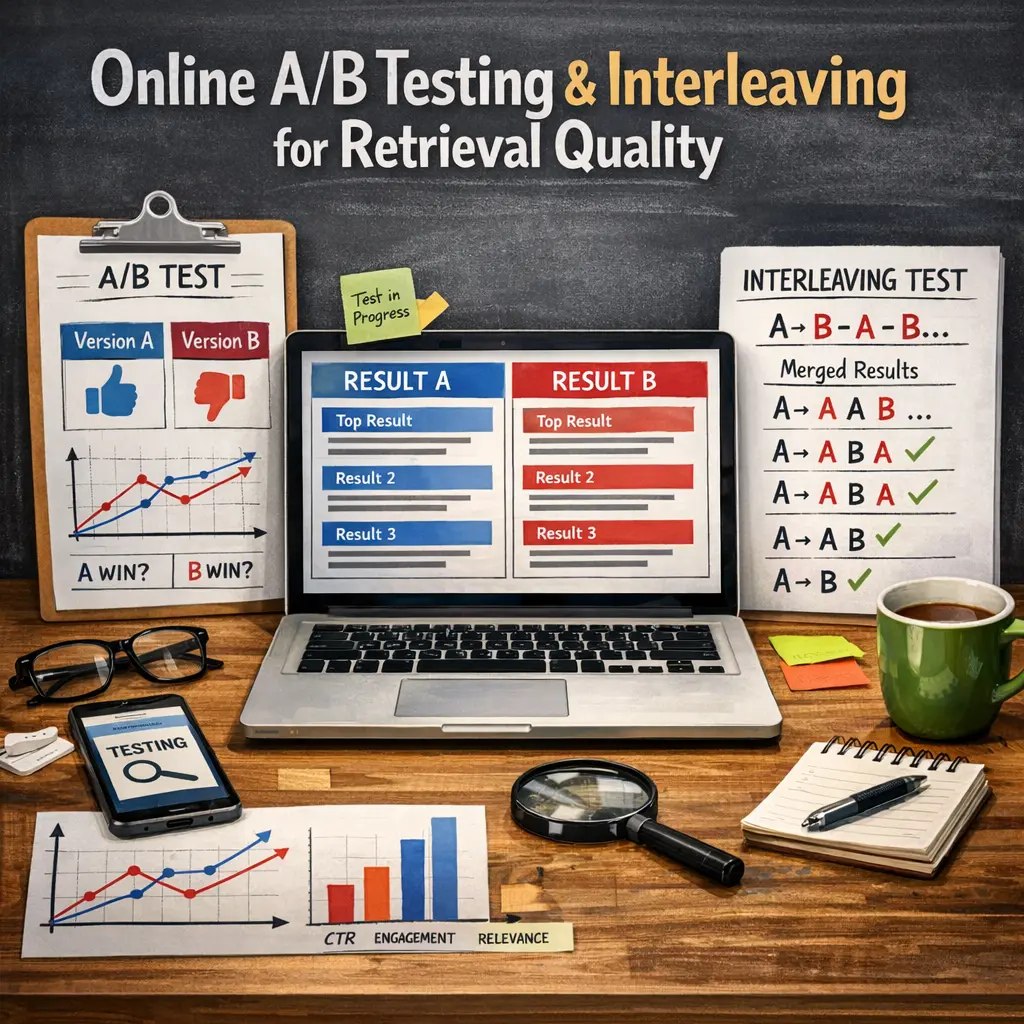
Online A/B testing and interleaving are experimental techniques used to evaluate and compare the effectiveness of different retrieval models in Retrieval-Augmented Generation (RAG) systems. A/B testing exposes users to different system versions to measure performance differences, while interleaving mixes results from multiple models within a single interaction, allowing for more sensitive, user-centric comparisons. These methods help optimize retrieval quality, ensuring RAG systems provide more relevant and accurate information to users.
Online A/B Testing and Interleaving for Retrieval Quality
Online A/B testing and interleaving are experimental techniques used to evaluate and compare the effectiveness of different retrieval models in Retrieval-Augmented Generation (RAG) systems. A/B testing exposes users to different system versions to measure performance differences, while interleaving mixes results from multiple models within a single interaction, allowing for more sensitive, user-centric comparisons. These methods help optimize retrieval quality, ensuring RAG systems provide more relevant and accurate information to users.
💡 Key Takeaways
- Understand how to design online A/B tests for retrieval systems, including randomization, controls, and measuring impact with statistical significance.
- Learn how interleaving techniques compare two ranking algorithms by intermixing results to estimate retrieval quality without requiring explicit relevance judgments.
- Identify key online retrieval quality metrics (e.g., click-through rate, dwell time, NDCG@k, precision@k) and how to interpret them in experiments.
- Recognize practical pitfalls and best practices for online testing of retrieval quality, including statistical power, multiple testing, traffic allocation, monitoring, and guardrails.
❓ Frequently Asked Questions
What is online A/B testing in retrieval quality?
An experiment where users are randomly assigned to two retrieval configurations (A and B) to compare which yields more relevant results, using predefined success metrics.
What is interleaving in retrieval evaluation?
A technique that merges results from two ranking algorithms into a single list and uses user interactions (clicks) to infer which ranking users prefer, often with less traffic than full A/B tests.
What metrics are commonly used to judge retrieval quality in these tests?
Metrics such as click-through rate (CTR), NDCG@k, precision@k, MAP, dwell time, and conversions, depending on the goal.
When should you use interleaving versus full A/B testing for retrieval quality?
Use interleaving for fast, low-traffic comparison of ranking signals to get early feedback; use traditional A/B tests for robust, long-term impact with more traffic and higher confidence.