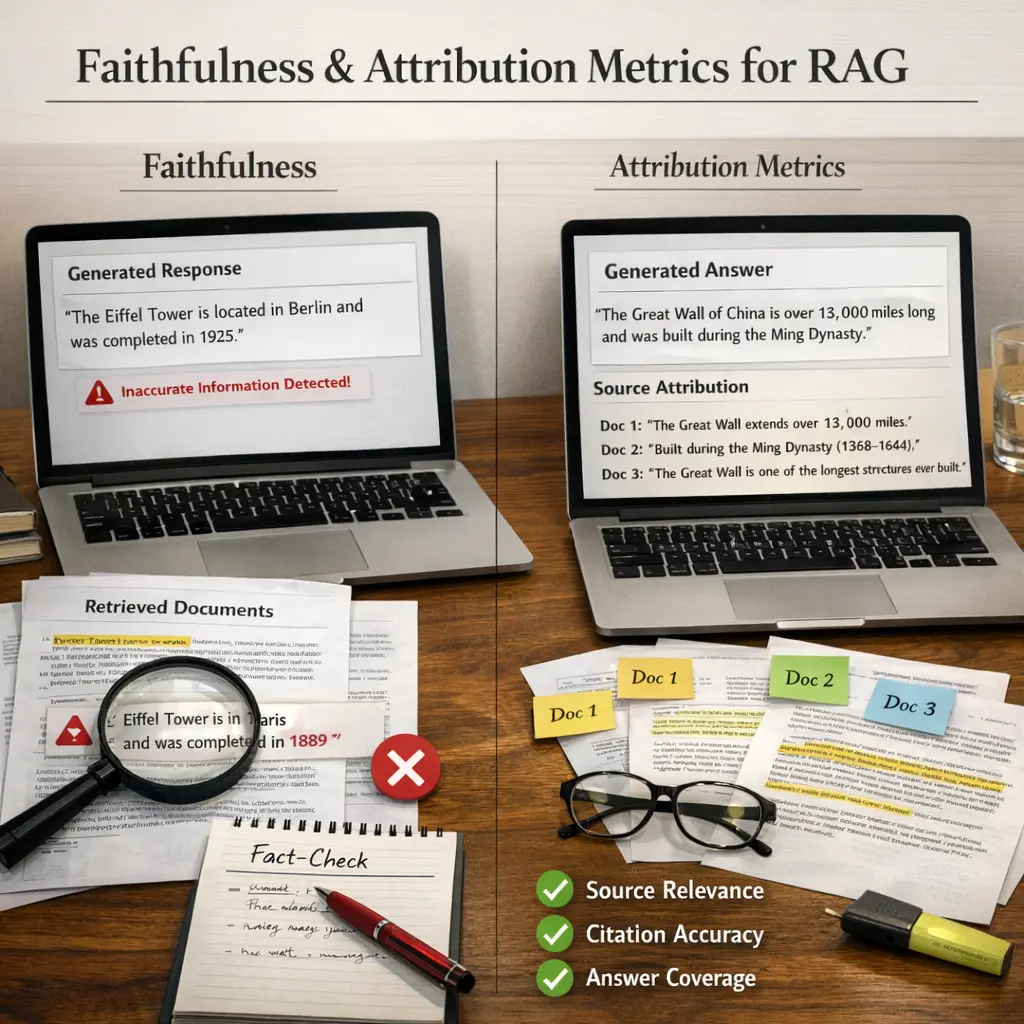
Passage scoring features and signals in advanced Retrieval-Augmented Generation (RAG) techniques refer to the various metrics and indicators used to evaluate and rank retrieved text passages for relevance and quality. These features may include semantic similarity, contextual alignment, keyword overlap, source credibility, and user intent matching. By leveraging sophisticated scoring signals, advanced RAG systems can more accurately select passages that best support or enhance the generated responses, leading to improved answer accuracy and user satisfaction.
Passage Scoring Features and Signals
Passage scoring features and signals in advanced Retrieval-Augmented Generation (RAG) techniques refer to the various metrics and indicators used to evaluate and rank retrieved text passages for relevance and quality. These features may include semantic similarity, contextual alignment, keyword overlap, source credibility, and user intent matching. By leveraging sophisticated scoring signals, advanced RAG systems can more accurately select passages that best support or enhance the generated responses, leading to improved answer accuracy and user satisfaction.

💡 Key Takeaways
- Understand passage scoring basics and why signals influence relevance.
- Identify core features used to score passages (term frequency, proximity, and query-passage similarity).
- Recognize secondary signals such as context, length normalization, recency, and source credibility that can affect scoring.
- Learn how to interpret feature impacts on rankings and how to tune scoring in practical scenarios.
❓ Frequently Asked Questions
What is passage scoring in NLP?
Passage scoring assigns a relevance score to a text passage to indicate how well it answers a question or matches a query, used to rank passages.
What are common features used to score passages?
Common features include lexical overlap, TF-IDF/BM25 similarity, semantic similarity from embeddings, proximity of question terms, passage length, and presence of candidate answer phrases.
What signals suggest a passage is likely to contain the answer?
Signals include high semantic similarity to the question, key terms from the question appearing in the passage, and the presence of potential answer spans in the right context.
How are features combined to produce a final score?
Features are combined by a scoring model (rule-based or learned) that outputs a numeric score; weights are learned from data to improve ranking accuracy.