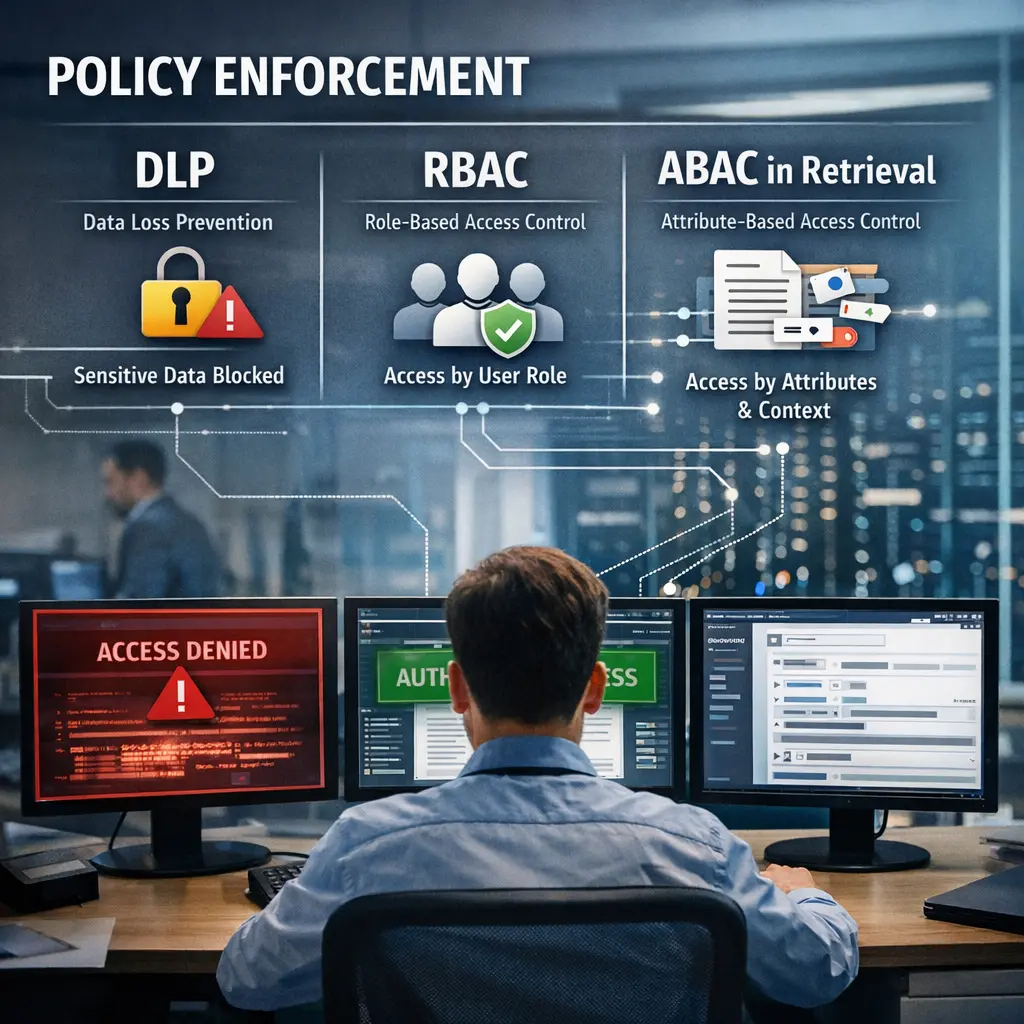
Policy enforcement in Retrieval-Augmented Generation (RAG) ensures secure and compliant data access by implementing mechanisms like Data Loss Prevention (DLP), Role-Based Access Control (RBAC), and Attribute-Based Access Control (ABAC). DLP prevents unauthorized data exposure, RBAC restricts retrieval based on user roles, and ABAC adds granular control using user and resource attributes. Together, they safeguard sensitive information during retrieval and generation processes, maintaining organizational policies and regulatory requirements.
Policy Enforcement: DLP, RBAC, and ABAC in Retrieval
Policy enforcement in Retrieval-Augmented Generation (RAG) ensures secure and compliant data access by implementing mechanisms like Data Loss Prevention (DLP), Role-Based Access Control (RBAC), and Attribute-Based Access Control (ABAC). DLP prevents unauthorized data exposure, RBAC restricts retrieval based on user roles, and ABAC adds granular control using user and resource attributes. Together, they safeguard sensitive information during retrieval and generation processes, maintaining organizational policies and regulatory requirements.
💡 Key Takeaways
- Identify what DLP, RBAC, and ABAC mean and how they function in data retrieval workflows.
- Compare RBAC and ABAC: when to use roles vs attributes to grant permissions in retrieval systems.
- Explain how DLP policies intersect with access control to prevent sensitive data leakage during retrieval.
- Describe common architectures for policy enforcement in retrieval pipelines (policy decision point and policy enforcement point) and their trade-offs.
❓ Frequently Asked Questions
What does DLP stand for and what role does it play in retrieval policy enforcement?
DLP stands for Data Loss Prevention. In retrieval systems, DLP detects sensitive data in requests or responses, blocks or redacts it, and logs incidents to prevent data leaks.
What is RBAC and how does it determine who can retrieve data?
RBAC, or Role-Based Access Control, grants retrieval permissions based on user roles. Each role defines which datasets or data sensitivity levels are accessible, enforcing least-privilege access.
What is ABAC and how is it different from RBAC in a retrieval context?
ABAC, Attribute-Based Access Control, uses user, resource, action, and environment attributes to decide access. Unlike RBAC's fixed roles, ABAC enables context-aware, fine-grained retrieval decisions (e.g., department, clearance, time).
How do DLP, RBAC, and ABAC work together to enforce retrieval policies?
RBAC/ABAC determine who can retrieve what and under which conditions, while DLP monitors the data content to prevent leaks. Together they provide layered security: access control plus data protection and auditing.