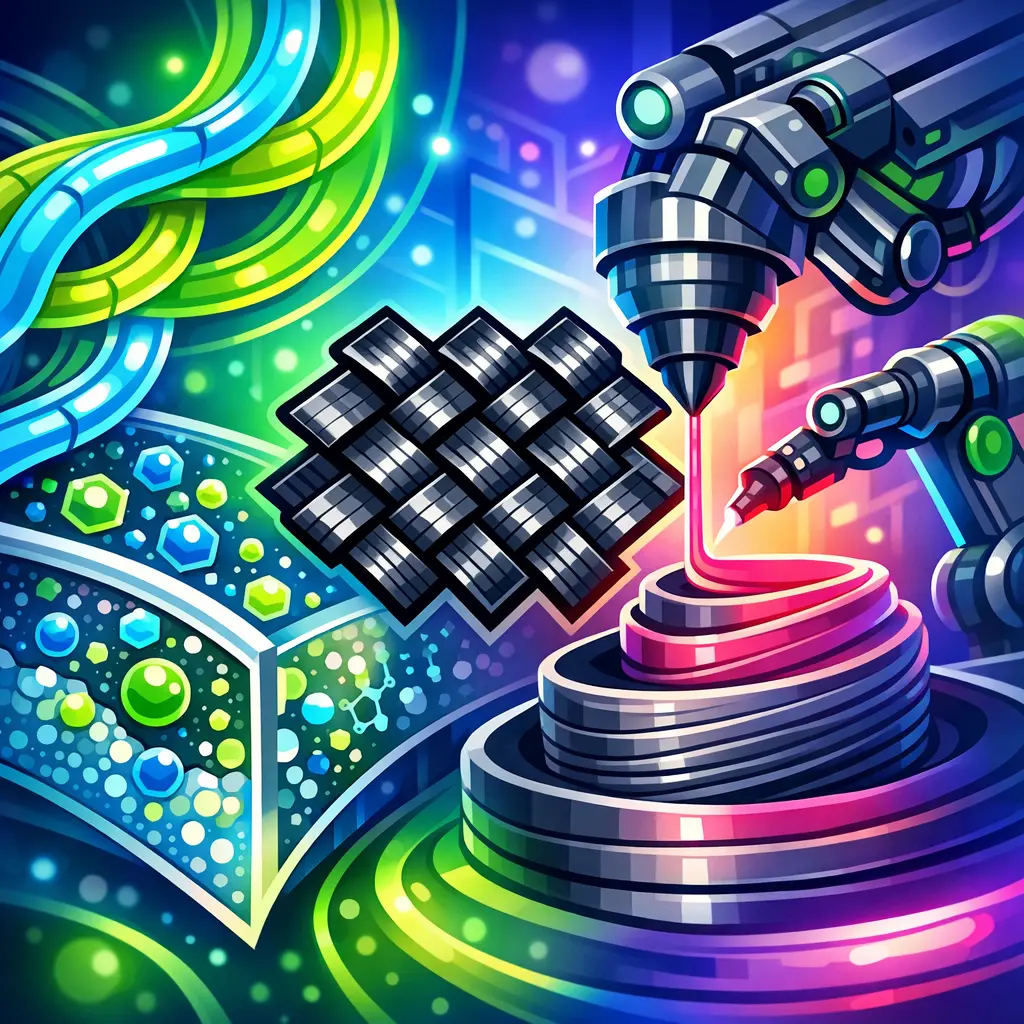
Polymers, Composites & Advanced Manufacturing in engineering and technology careers involve designing, developing, and producing materials with tailored properties for various applications. Professionals in this field work with plastics, fiber-reinforced materials, and cutting-edge manufacturing techniques like 3D printing. They contribute to industries such as aerospace, automotive, and healthcare by creating lightweight, durable, and innovative products, often focusing on sustainability and efficiency in material usage and production processes.
Polymers, Composites & Advanced Manufacturing
Polymers, Composites & Advanced Manufacturing in engineering and technology careers involve designing, developing, and producing materials with tailored properties for various applications. Professionals in this field work with plastics, fiber-reinforced materials, and cutting-edge manufacturing techniques like 3D printing. They contribute to industries such as aerospace, automotive, and healthcare by creating lightweight, durable, and innovative products, often focusing on sustainability and efficiency in material usage and production processes.
💡 Key Takeaways
- Distinguish polymers from composites and identify typical applications for each.
- Explain the difference between thermoplastics and thermosets and how processing affects performance.
- Describe how composites are made (matrix and reinforcement) and common types such as fiber-reinforced and particulate-reinforced.
- Identify key advanced manufacturing methods for polymers and composites (e.g., additive manufacturing, molding, extrusion, and layup) and when to use them.
❓ Frequently Asked Questions
What is a polymer?
A large molecule built from repeating units (monomers) linked together; polymers include plastics, rubbers, fibers, and resins.
What is a composite material?
A material made from two or more constituents with different properties, typically a reinforcing phase embedded in a matrix to improve strength, stiffness, or durability.
What is the difference between thermoplastics and thermosets?
Thermoplastics soften or melt when heated and can be reshaped; thermosets cure into a rigid network and cannot be melted again.
What are common advanced manufacturing approaches for polymers and composites?
Techniques include additive manufacturing (3D printing), resin transfer molding, autoclave curing, and automated fiber placement to build complex parts with high performance.