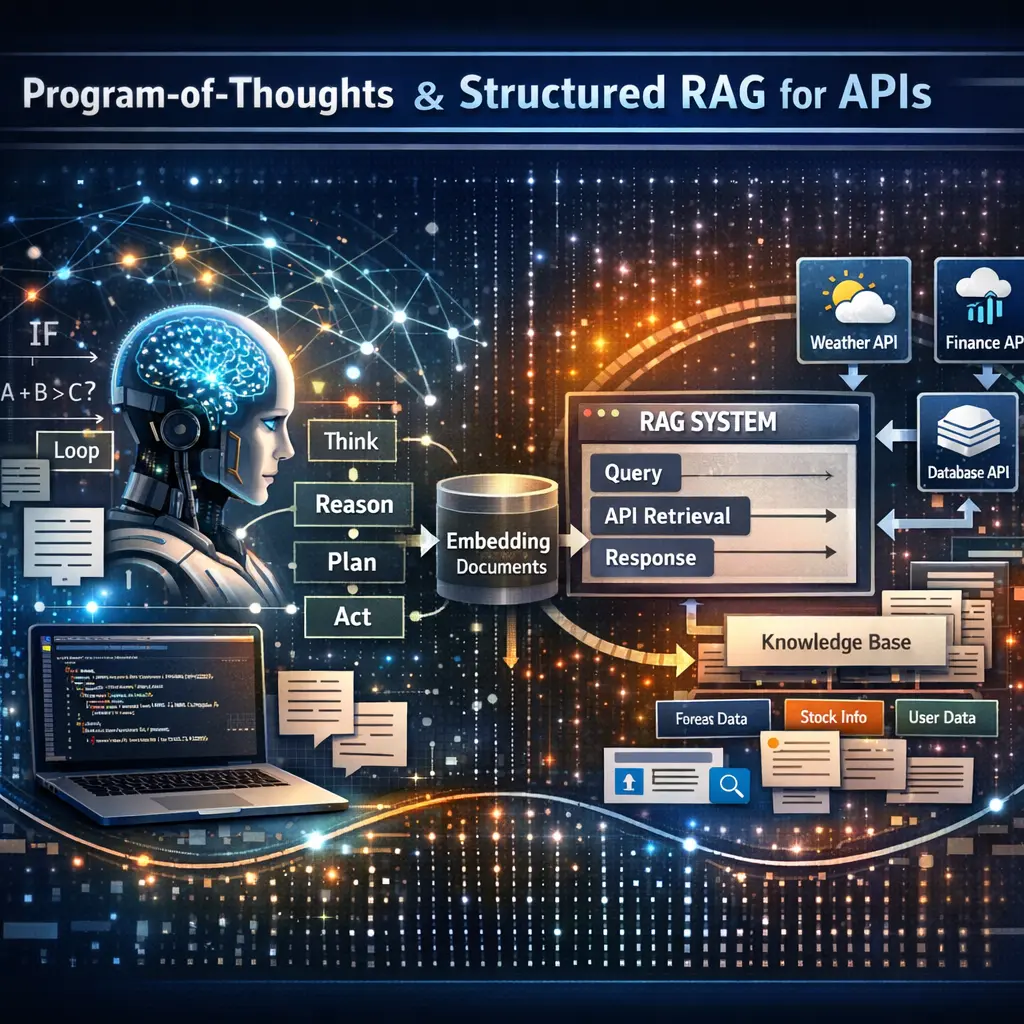
Program-of-Thoughts and Structured RAG for APIs refers to an advanced approach in Retrieval-Augmented Generation (RAG) where the reasoning process is broken down into structured, step-by-step “thoughts” or sub-tasks. This method enhances API interactions by retrieving relevant information and organizing it logically, allowing large language models to generate more accurate, coherent, and context-aware responses, especially for complex queries that require multiple reasoning or retrieval steps.
Program-of-Thoughts and Structured RAG for APIs
Program-of-Thoughts and Structured RAG for APIs refers to an advanced approach in Retrieval-Augmented Generation (RAG) where the reasoning process is broken down into structured, step-by-step “thoughts” or sub-tasks. This method enhances API interactions by retrieving relevant information and organizing it logically, allowing large language models to generate more accurate, coherent, and context-aware responses, especially for complex queries that require multiple reasoning or retrieval steps.
💡 Key Takeaways
- Understand what Program-of-Thoughts (PoT) is and how it guides step-by-step reasoning before making API calls.
- Learn Structured RAG and how it grounds reasoning by retrieving and using API docs and data.
- Design stepwise API interaction workflows using PoT, including when to call endpoints, how to parse responses, and how to handle errors.
- Evaluate the benefits and trade-offs of PoT + Structured RAG for APIs, such as improved explainability and accuracy, with attention to latency and complexity.
❓ Frequently Asked Questions
What is Program-of-Thoughts (PoT) in AI?
Program-of-Thoughts is an approach where the model produces a structured, step-by-step reasoning trace before delivering the final answer, making its thought process explicit for better accuracy and debugging.
What is Structured Retrieval-Augmented Generation (Structured RAG) and why is it useful for APIs?
Structured RAG augments generation with retrieved information, organizing it into structured pieces (like endpoints, parameters, and schemas) so the model can cite and use precise API documentation when answering.
How do PoT and Structured RAG complement each other for API tasks?
PoT makes the reasoning transparent, while Structured RAG provides grounded, cited API context. Together they improve correctness, traceability, and reduce hallucinations in API-related answers.
What are the basic steps to implement PoT + Structured RAG for an API project?
Collect API docs and specs, set up a retrieval index for them, design PoT prompts that outline step-by-step reasoning, feed structured retrieval results into generation, and validate outputs against the docs.
What are common pitfalls to watch out for with PoT + Structured RAG?
Outdated or mismatched docs, latency from retrieval, hallucinations when sources aren’t properly grounded, and failing to cite sources or verify against the API specs.