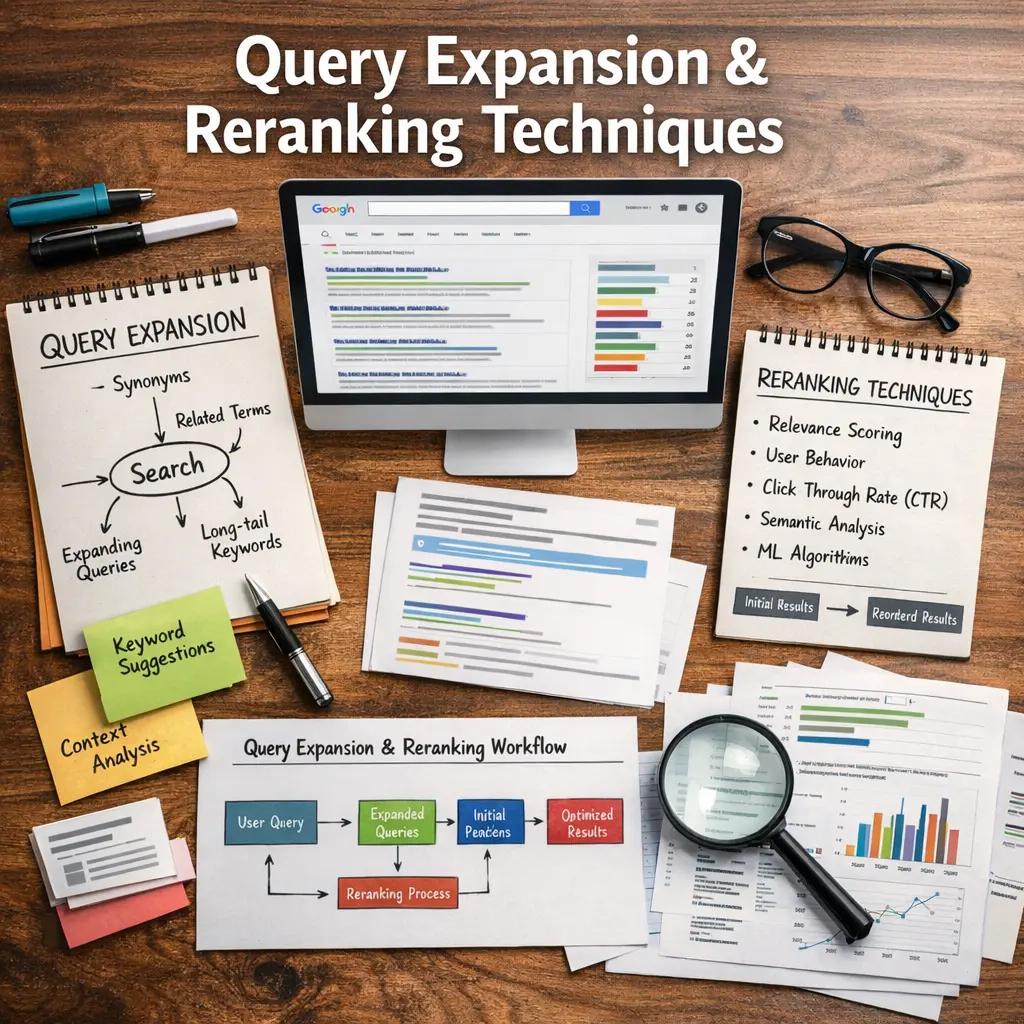
Query expansion and reranking techniques in Retrieval-Augmented Generation (RAG) enhance information retrieval by first broadening the initial query with related terms or concepts to capture more relevant documents. After retrieval, reranking algorithms reorder results based on relevance, often using deep learning models. This process ensures that the most pertinent information is provided to the generation model, improving the accuracy and quality of the final generated responses.
Query Expansion & Reranking Techniques+50
Query expansion and reranking techniques in Retrieval-Augmented Generation (RAG) enhance information retrieval by first broadening the initial query with related terms or concepts to capture more relevant documents. After retrieval, reranking algorithms reorder results based on relevance, often using deep learning models. This process ensures that the most pertinent information is provided to the generation model, improving the accuracy and quality of the final generated responses.
💡 Key Takeaways
- Understand what query expansion is and how adding related terms or synonyms can improve search recall and relevance.
- Describe common query expansion methods, including explicit feedback, pseudo relevance feedback, and embedding-based approaches.
- Explain reranking and how it refines results by reordering top-k documents using learned models and additional signals.
- Discuss practical trade-offs, such as potential query drift, added latency, and how to evaluate ranking quality with metrics like NDCG or MAP.
❓ Frequently Asked Questions
What is query expansion?
Query expansion adds related terms to the original query to broaden results and better capture the user's intent.
What is reranking?
Reranking reorders the top retrieval results using a second-stage model that analyzes more features or context for improved relevance.
What are common query expansion methods?
Methods include pseudo-relevance feedback, synonyms/ontologies, and embedding-based expansions using word or phrase vectors.
How does reranking improve results?
Reranking applies deeper analysis (e.g., learning-to-rank or neural models) to refine ordering beyond the initial fast ranking.
When should these techniques be used?
They are helpful when initial results miss relevance or user satisfaction is low, common in search and information retrieval systems.