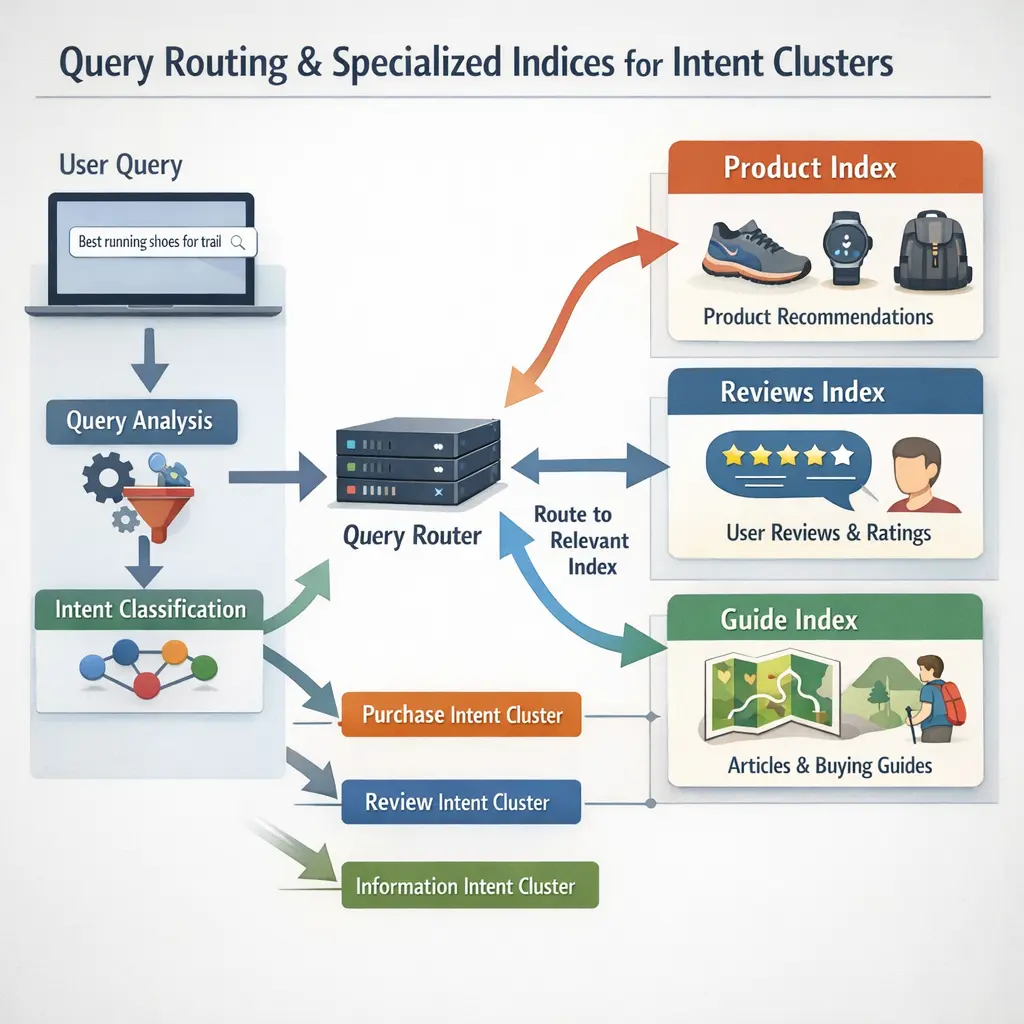
Query Routing and Specialized Indices for Intent Clusters in Retrieval-Augmented Generation (RAG) refers to directing user queries to the most relevant subsets of indexed data, organized by user intent. Specialized indices are created for different intent clusters, enabling faster and more accurate retrieval of information. By routing queries to these targeted indices, RAG systems enhance response quality and efficiency, ensuring that generated answers are contextually appropriate and highly relevant to the user’s underlying intent.
Query Routing and Specialized Indices for Intent Clusters
Query Routing and Specialized Indices for Intent Clusters in Retrieval-Augmented Generation (RAG) refers to directing user queries to the most relevant subsets of indexed data, organized by user intent. Specialized indices are created for different intent clusters, enabling faster and more accurate retrieval of information. By routing queries to these targeted indices, RAG systems enhance response quality and efficiency, ensuring that generated answers are contextually appropriate and highly relevant to the user’s underlying intent.
💡 Key Takeaways
- Understand the concept of query routing and how it directs queries to the right intent cluster.
- Learn how specialized indices accelerate retrieval within intent clusters and improve accuracy.
- Explore design choices and trade-offs for routing strategies, index maintenance, and scalability.
- Apply practical steps to implement and evaluate query routing and specialized indices for intent clustering.
❓ Frequently Asked Questions
What is query routing?
Directing a user's query to the most relevant index or data source to improve relevance and speed of results.
What are specialized indices?
Indexes tailored for a specific domain or query type (e.g., product catalogs, support articles) to boost precision and retrieval efficiency.
What are intent clusters?
Groupings of similar user intents inferred from queries, used to determine which index or dataset to search.
How do query routing and specialized indices work together?
The system infers the query's intent cluster, selects the matching specialized index, and routes the query there to retrieve targeted results.
Why use this approach?
It improves result relevance, reduces latency, and scales search as data grows by focusing queries on the most suitable data sources.