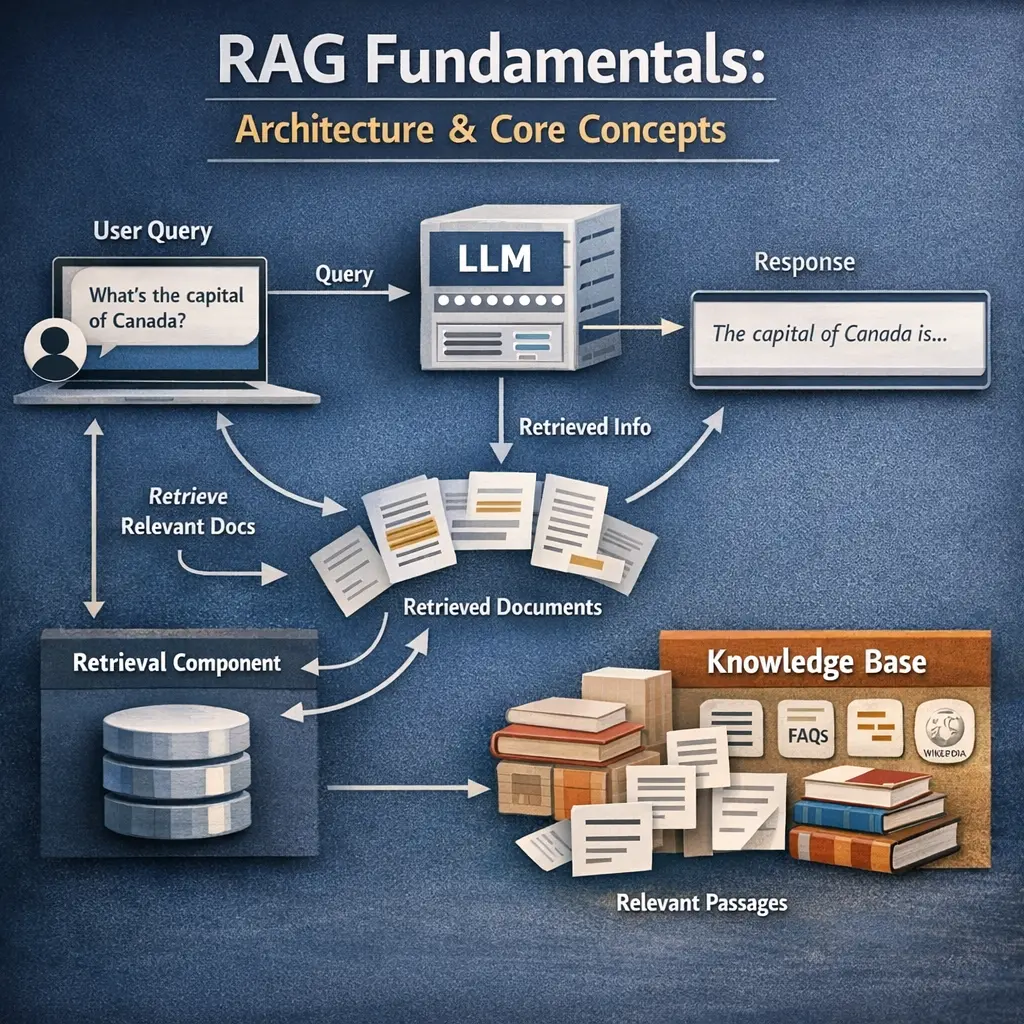
RAG Fundamentals: Architecture & Core Concepts refer to the foundational elements of Retrieval-Augmented Generation (RAG), an AI framework that combines retrieval and generation. In RAG, a retriever fetches relevant documents from a large corpus, and a generator, typically a language model, synthesizes responses using both the retrieved information and its own knowledge. This hybrid approach enhances accuracy, relevance, and factual grounding in generated outputs, making RAG valuable for tasks like question answering and summarization.
RAG Fundamentals: Architecture & Core Concepts+50
RAG Fundamentals: Architecture & Core Concepts refer to the foundational elements of Retrieval-Augmented Generation (RAG), an AI framework that combines retrieval and generation. In RAG, a retriever fetches relevant documents from a large corpus, and a generator, typically a language model, synthesizes responses using both the retrieved information and its own knowledge. This hybrid approach enhances accuracy, relevance, and factual grounding in generated outputs, making RAG valuable for tasks like question answering and summarization.
💡 Key Takeaways
- Understand the RAG architecture: retriever, generator, and fusion components.
- Learn how embeddings and vector stores enable fast retrieval of relevant documents.
- See how retrieved content is integrated into the model's output to ground responses.
- Identify common use cases, limitations, and evaluation approaches for RAG systems.
❓ Frequently Asked Questions
What is Retrieval-Augmented Generation (RAG)?
A framework that combines a retriever to fetch relevant documents from a knowledge base with a generator that uses those documents to produce grounded, factual answers.
What are the main components of a RAG architecture?
Retriever (finds relevant passages), Generator/Reader (produces the answer using retrieved docs), and a knowledge source (document store). Optional: fusion or ranking modules to combine evidence.
What are RAG-Token and RAG-Sequence variants?
RAG-Token uses retrieved documents to inform each generated token; RAG-Sequence concatenates the retrieved passages and generates the answer from them. Both ground generation in evidence but differ in how evidence is integrated.
How does retrieval improve accuracy and reduce hallucinations?
By grounding answers in actual documents, it reduces unsupported claims. Effectiveness depends on the quality of the knowledge base and the retriever's accuracy.
What retrieval methods are common in RAG systems?
Dense retrieval with learned embeddings (e.g., DPR) using vector indices (e.g., FAISS), sparse retrieval like BM25, or hybrids. Retrievers can be trained jointly with the generator.