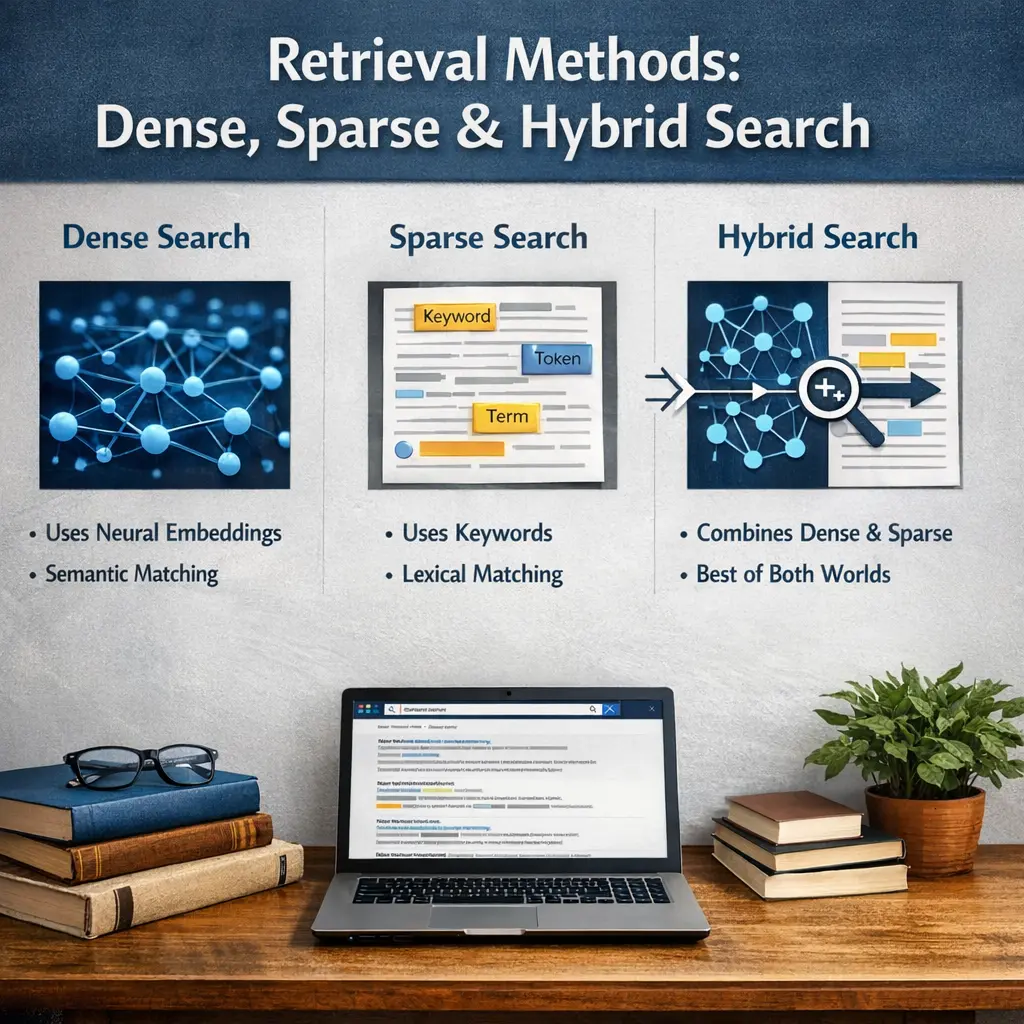
Retrieval methods in RAG refer to techniques for finding relevant information from large datasets. Dense search uses neural embeddings to match queries and documents based on semantic similarity, while sparse search relies on keyword or token overlap, such as traditional TF-IDF or BM25 methods. Hybrid search combines both approaches, leveraging the strengths of each to improve retrieval accuracy and relevance, thus enhancing the performance of retrieval-augmented generation systems.
Retrieval Methods: Dense, Sparse & Hybrid Search+50
Retrieval methods in RAG refer to techniques for finding relevant information from large datasets. Dense search uses neural embeddings to match queries and documents based on semantic similarity, while sparse search relies on keyword or token overlap, such as traditional TF-IDF or BM25 methods. Hybrid search combines both approaches, leveraging the strengths of each to improve retrieval accuracy and relevance, thus enhancing the performance of retrieval-augmented generation systems.
💡 Key Takeaways
- Understand the difference between dense (vector) retrieval and sparse (keyword) retrieval and what each represents.
- Learn how hybrid search combines dense and sparse signals to improve result relevance.
- Identify use cases and trade-offs for dense, sparse, and hybrid search in terms of accuracy, latency, and scalability.
- Explore practical considerations for implementing these methods, including indexing, feature representations, and resource needs.
❓ Frequently Asked Questions
What is dense retrieval and how does it work?
Dense retrieval encodes queries and documents into dense vector representations using neural encoders; it uses vector similarity (like cosine or dot product) to match semantic meaning. It excels at paraphrase detection but needs vector indices and GPUs.
What is sparse retrieval and how does it work?
Sparse retrieval uses high‑dimensional sparse vectors (e.g., TF‑IDF or bag-of-words) with inverted indices to find exact keyword matches. It's fast and scalable, but less able to handle synonyms or paraphrases.
What is a hybrid retrieval approach?
Hybrid retrieval combines dense and sparse signals, often by fusing scores or reranking with both types of features, to capture semantic meaning and exact keyword matches.
When should you use each method?
Use sparse retrieval for exact keyword matching and efficiency; use dense retrieval for semantic understanding and paraphrase handling; use hybrid to balance accuracy and robustness across varied queries.