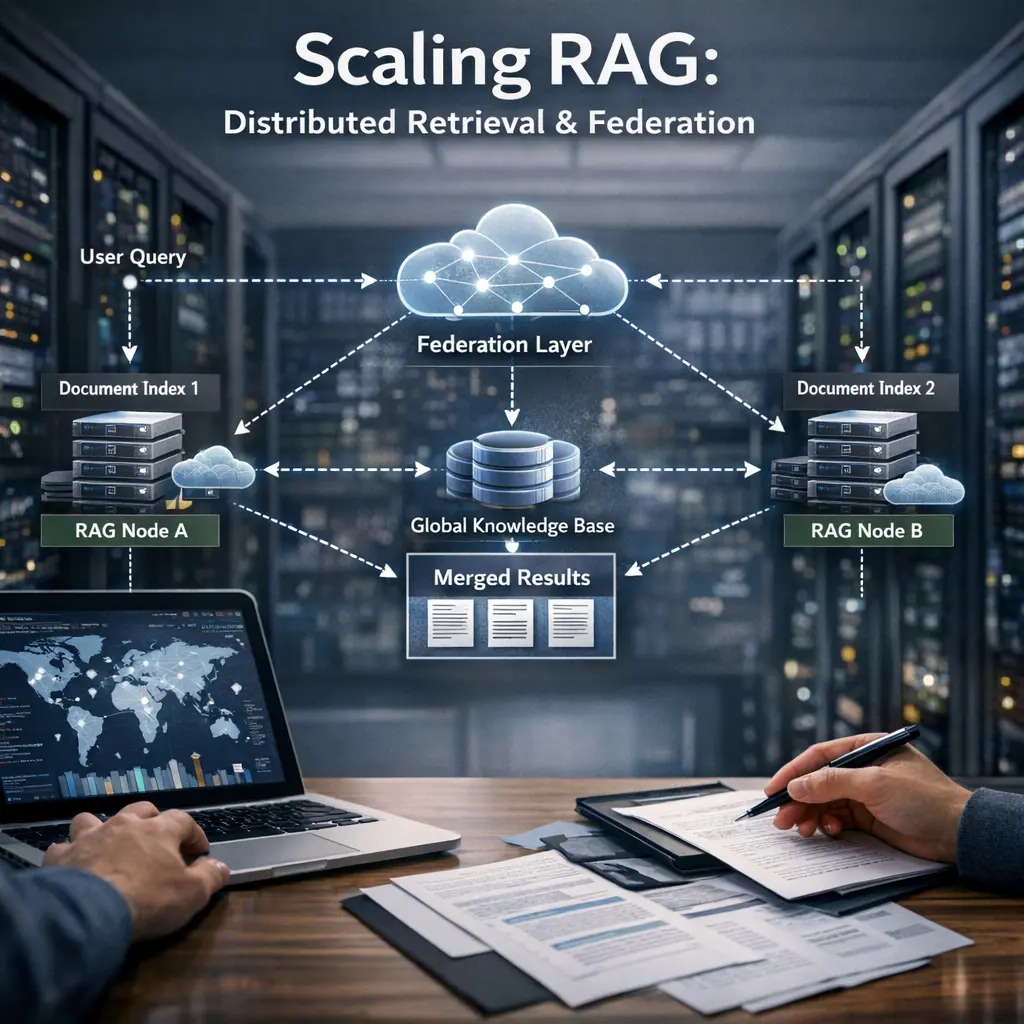
Scaling RAG with distributed retrieval and federation involves enhancing Retrieval-Augmented Generation (RAG) systems to efficiently search and aggregate information from multiple, distributed data sources. By leveraging distributed retrieval, queries are processed across various databases or indexes in parallel, improving speed and coverage. Federation techniques then combine results from these diverse sources, ensuring comprehensive and relevant responses. These advanced methods enable RAG models to scale effectively, handle larger datasets, and deliver more accurate, context-rich outputs.
Scaling RAG: Distributed Retrieval & Federation
Scaling RAG with distributed retrieval and federation involves enhancing Retrieval-Augmented Generation (RAG) systems to efficiently search and aggregate information from multiple, distributed data sources. By leveraging distributed retrieval, queries are processed across various databases or indexes in parallel, improving speed and coverage. Federation techniques then combine results from these diverse sources, ensuring comprehensive and relevant responses. These advanced methods enable RAG models to scale effectively, handle larger datasets, and deliver more accurate, context-rich outputs.
💡 Key Takeaways
- Grasp what Retrieval-Augmented Generation (RAG) is and why scaling the retrieval layer matters for large, multi-source corpora.
- Differentiate distributed retrieval from federation, and understand how federation enables access to multiple data sources without centralizing data.
- Learn how to design a distributed retrieval pipeline with partitioned indexes, multi-node vector stores, and efficient cross-source querying.
- Recognize challenges and trade-offs in distributed RAG and federation, including latency, data freshness, privacy, access control, and consistency.
- Identify practical evaluation metrics for distributed RAG (e.g., recall@K, MRR, latency) and how reranking and cross-source fusion affect performance.
❓ Frequently Asked Questions
What is Retrieval-Augmented Generation (RAG)?
RAG combines a language model with external knowledge by retrieving relevant documents or vectors and conditioning the generated output on that retrieved content.
What does distributed retrieval mean in a RAG system?
Distributed retrieval means running the retrieval step across multiple nodes or data sources, often using partitioned indices, to scale to large corpora and reduce latency.
What is federation in the context of RAG?
Federation connects several data sources or retrieval engines into a single query experience without moving data into one index, enabling cross-source retrieval with governance and access controls.
What are common challenges when scaling RAG with distributed retrieval and federation?
Challenges include latency, data freshness, consistency across sources, privacy and access control, cross-source ranking, index maintenance, and costs.