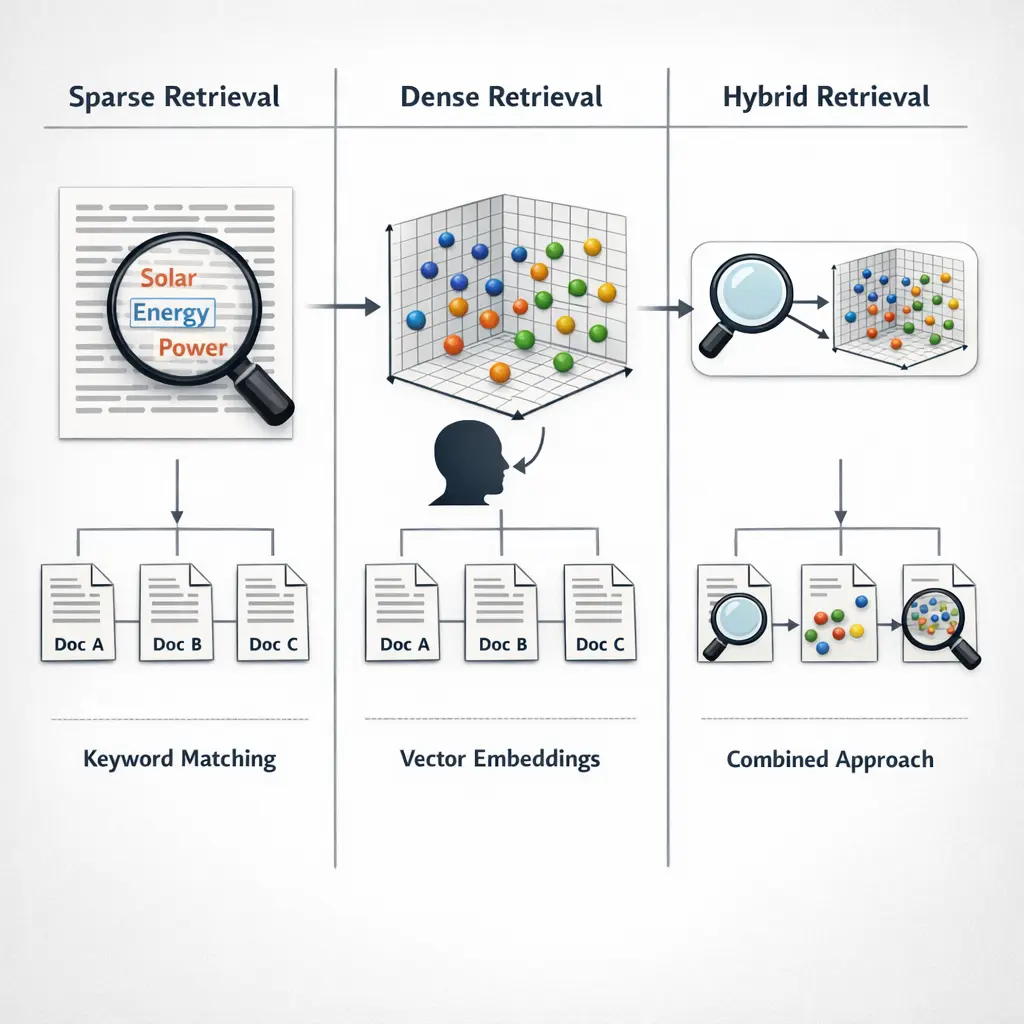
Sparse retrieval uses keyword-based methods (like BM25) to find relevant documents, focusing on exact term matches. Dense retrieval employs neural networks to encode text into vectors, capturing semantic meaning for more flexible matching. Hybrid retrieval combines both approaches, leveraging the precision of sparse methods and the contextual understanding of dense models. In advanced Retrieval-Augmented Generation (RAG), these techniques are integrated to optimize information retrieval, improving accuracy and relevance in generated responses.
Sparse vs Dense vs Hybrid Retrieval+50
Sparse retrieval uses keyword-based methods (like BM25) to find relevant documents, focusing on exact term matches. Dense retrieval employs neural networks to encode text into vectors, capturing semantic meaning for more flexible matching. Hybrid retrieval combines both approaches, leveraging the precision of sparse methods and the contextual understanding of dense models. In advanced Retrieval-Augmented Generation (RAG), these techniques are integrated to optimize information retrieval, improving accuracy and relevance in generated responses.
💡 Key Takeaways
- Understand sparse (lexical) retrieval vs dense (embedding-based) retrieval and how each signals relevance.
- Learn the trade-offs between speed, accuracy, and data requirements for sparse, dense, and hybrid approaches.
- Grasp how a hybrid retrieval system combines lexical and semantic signals, including reranking strategies.
- Get a high-level view of common algorithms and components (BM25, dense embeddings, approximate nearest neighbor search) and basic evaluation metrics.
❓ Frequently Asked Questions
What is sparse retrieval?
Sparse retrieval uses lexical representations (e.g., BM25, TF-IDF) and inverted indexes to match query terms with document terms. It's fast, scalable, and interpretable, but may miss semantic similarities.
What is dense retrieval?
Dense retrieval uses neural embeddings to represent queries and documents as dense vectors; similarity is measured with cosine or dot product. It captures semantics and synonyms but requires vector indexes and more compute.
What is hybrid retrieval?
Hybrid retrieval combines sparse and dense signals to select and rank results. It leverages both keyword matching and semantic similarity to improve recall and precision.
When should I use sparse, dense, or hybrid retrieval?
Use sparse when you need fast, keyword-driven results. Use dense for semantic matching and synonyms. Use hybrid when you want the benefits of both, understanding it adds complexity and resource needs.