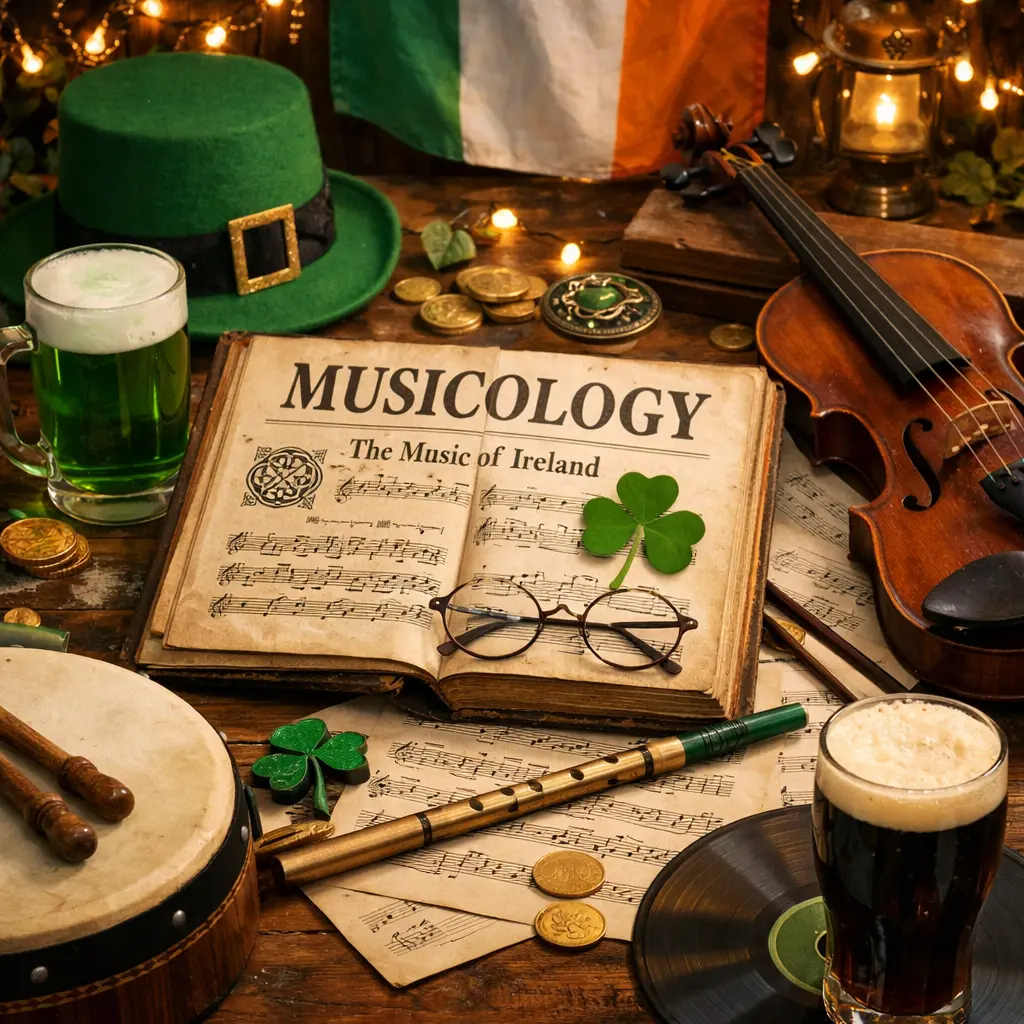
St. Patrick's Day and Musicology explores the rich musical traditions associated with the celebration of St. Patrick's Day, highlighting how Irish music—featuring instruments like the fiddle, tin whistle, and bodhrán—plays a central role in festivities. Musicologists study the evolution, cultural significance, and communal aspects of these musical practices, revealing how they foster Irish identity, connect communities, and preserve heritage through song, dance, and storytelling during St. Patrick's Day celebrations.
St. Patrick's Day and Musicology
St. Patrick's Day and Musicology explores the rich musical traditions associated with the celebration of St. Patrick's Day, highlighting how Irish music—featuring instruments like the fiddle, tin whistle, and bodhrán—plays a central role in festivities. Musicologists study the evolution, cultural significance, and communal aspects of these musical practices, revealing how they foster Irish identity, connect communities, and preserve heritage through song, dance, and storytelling during St. Patrick's Day celebrations.
💡 Key Takeaways
- Explore how St. Patrick's Day celebrations highlight Irish musical traditions and influence global audiences.
- Identify core elements of Irish traditional music (reels, jigs, hornpipes) and common instruments (fiddle, tin whistle, uilleann pipes, bodhrán) heard on St. Patrick's Day.
- Learn how musicology analyzes Irish tunes—origins, manuscript transmission, oral tradition, and performance practices—within festive settings.
- Understand the cultural significance of St. Patrick's Day music in Irish identity and its cross-cultural impact.
❓ Frequently Asked Questions
What is musicology?
Musicology is the scholarly study of music, including its history, theory, performance, and cultural contexts.
How does St. Patrick's Day relate to Irish traditional music?
The holiday celebrates Irish culture, where traditional music—reels, jigs, and hornpipes—often features in parades, sessions, and dances.
What are common instruments in Irish traditional music?
Fiddle, tin whistle, flute, bodhrán, uilleann pipes, accordion, concertina, harp, and bouzouki.
What is the difference between a reel and a jig?
Reels are usually in 4/4 time with a fast tempo; jigs are in 6/8 time with a lilting, swing feel.
What is ethnomusicology?
Ethnomusicology is the study of music in its cultural context, including how communities create and share musical traditions—such as Irish folk music.