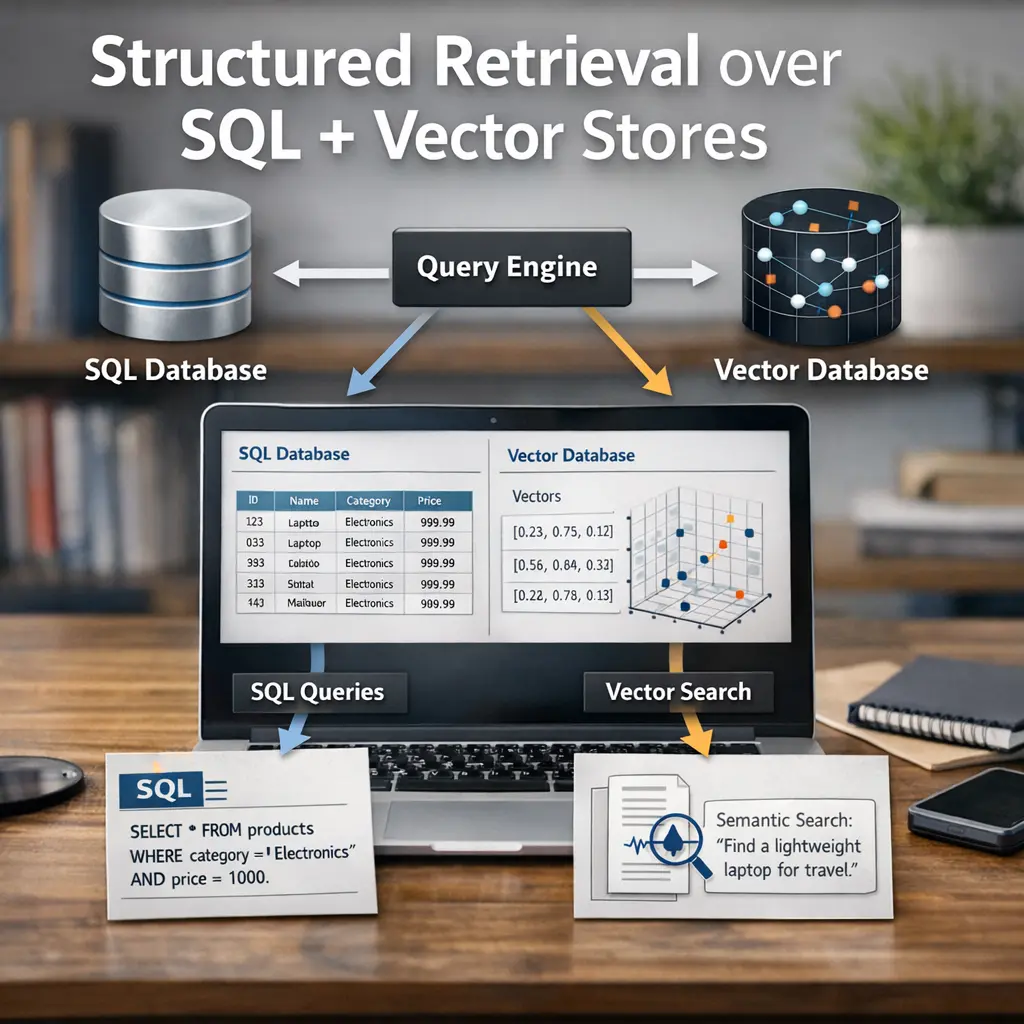
Structured Retrieval over SQL + Vector Stores (Advanced RAG Techniques) refers to combining traditional SQL databases, which handle structured data and queries, with vector stores that manage unstructured data using embeddings. This hybrid approach enables advanced Retrieval-Augmented Generation (RAG), allowing AI systems to efficiently access and integrate both structured and unstructured information, improving the relevance and accuracy of generated responses by leveraging the strengths of both data storage and retrieval methods.
Structured Retrieval over SQL + Vector Stores
Structured Retrieval over SQL + Vector Stores (Advanced RAG Techniques) refers to combining traditional SQL databases, which handle structured data and queries, with vector stores that manage unstructured data using embeddings. This hybrid approach enables advanced Retrieval-Augmented Generation (RAG), allowing AI systems to efficiently access and integrate both structured and unstructured information, improving the relevance and accuracy of generated responses by leveraging the strengths of both data storage and retrieval methods.
💡 Key Takeaways
- Understand what structured retrieval means and how SQL queries can be combined with vector similarity search to retrieve both structured attributes and semantically relevant results.
- Learn the role of vector stores (embeddings) in enabling semantic search and how they complement relational SQL data.
- Visualize a typical hybrid pipeline: store data in SQL, generate embeddings, persist in a vector store, and run hybrid queries that filter with SQL and rank by vector similarity.
- Identify key trade-offs and best practices, including latency, indexing costs, data consistency, and when to use approximate vector search versus exact SQL filters.
❓ Frequently Asked Questions
What is structured retrieval in the context of a SQL + vector store system?
Structured retrieval combines SQL-based, schema-driven querying with semantic search in a vector store to fetch exact results and semantically relevant items.
What is a vector store and what does it store?
A vector store stores high-dimensional embeddings (vectors) of items and their metadata, enabling fast similarity search to find items semantically close to a query.
How do SQL and vector stores complement each other?
SQL handles exact matches and filters on structured fields; vector stores capture semantic similarity. Together, they can filter candidates with SQL and rank them by vector similarity.
What is the practical use of Structured Retrieval over SQL + Vector Stores?
It enables accurate, scalable search or QA by combining precise database queries with semantic ranking, useful for knowledge bases, documents, and product catalogs.