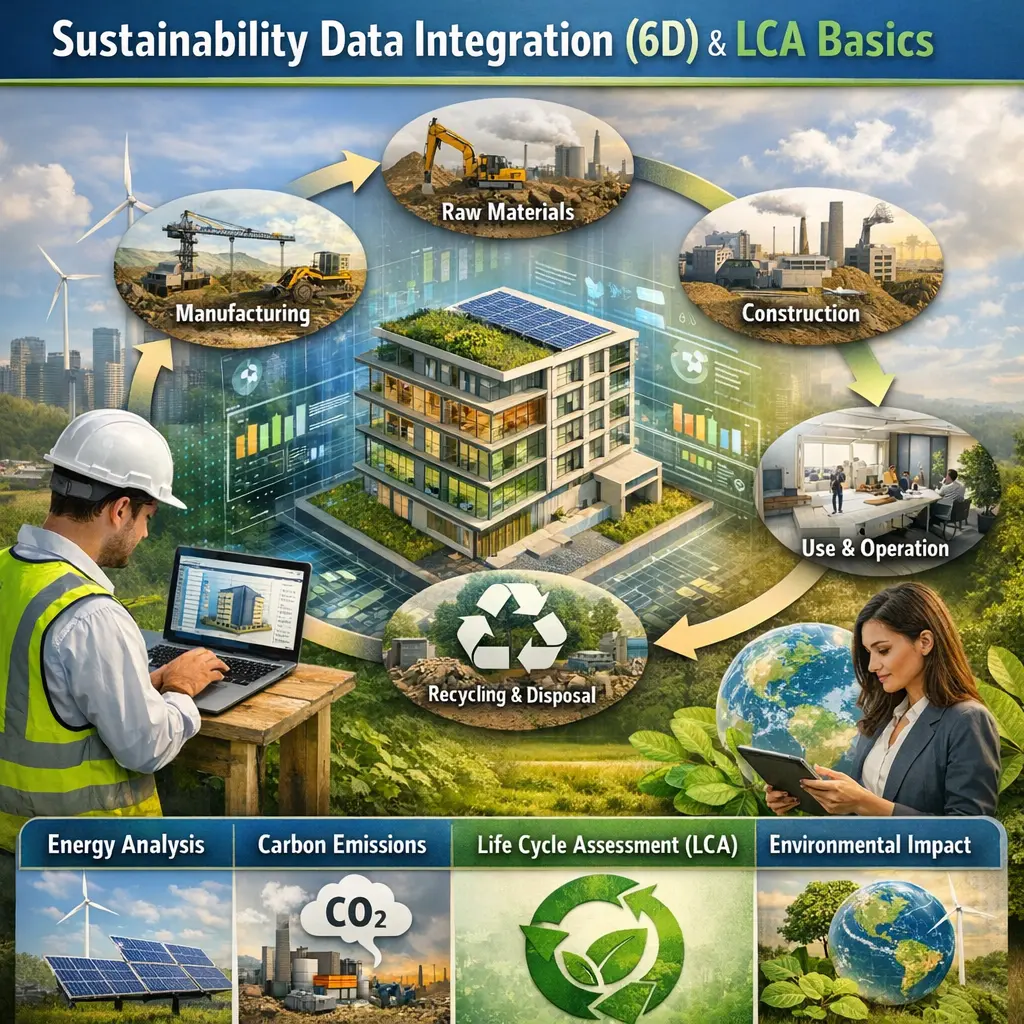
Sustainability Data Integration (6D) involves embedding environmental and sustainability data, such as energy use and carbon footprint, into digital building models. LCA (Life Cycle Assessment) basics refer to evaluating the environmental impacts of construction materials and processes throughout a building’s life cycle. Digital applications for construction information combine 6D data and LCA to enable informed decision-making, optimize resource use, and minimize environmental impact during design, construction, and operation.
Sustainability Data Integration (6D) and LCA Basics
Sustainability Data Integration (6D) involves embedding environmental and sustainability data, such as energy use and carbon footprint, into digital building models. LCA (Life Cycle Assessment) basics refer to evaluating the environmental impacts of construction materials and processes throughout a building’s life cycle. Digital applications for construction information combine 6D data and LCA to enable informed decision-making, optimize resource use, and minimize environmental impact during design, construction, and operation.
💡 Key Takeaways
- Understand the basics of Life Cycle Assessment (LCA) and the environmental impacts evaluated across a product's life cycle (cradle to grave).
- Learn what Sustainability Data Integration (6D) means and why integrating data from multiple sources is essential for accurate LCAs.
- Identify key data quality and standardization needs for LCAs, including functional units, system boundaries, units of measure, and data harmonization.
- Get an overview of the LCA workflow (goal and scope, inventory analysis, impact assessment, interpretation) and how to read and communicate results.
❓ Frequently Asked Questions
What is Life Cycle Assessment (LCA)?
A method to assess environmental impacts of a product or service across its life cycle: from raw material extraction to production, use, and end-of-life disposal or recycling.
What does Sustainability Data Integration (6D) mean here?
A framework for combining data from multiple sources to analyze sustainability performance. The '6D' typically refers to six data dimensions used to harmonize data (e.g., quality, provenance, governance, interoperability, timeliness, and coverage).
Why is data quality important in LCA?
Because LCA results rely on input data; incomplete or inaccurate data can misestimate environmental impacts and mislead decisions.
What are common data sources for LCA?
Lifecycle inventory databases (e.g., Ecoinvent), supplier process data, energy and emissions datasets, transportation data, and waste statistics.
How can LCA findings support sustainability decisions?
By identifying hotspot impacts, comparing scenarios, and guiding improvement priorities to reduce environmental burdens.