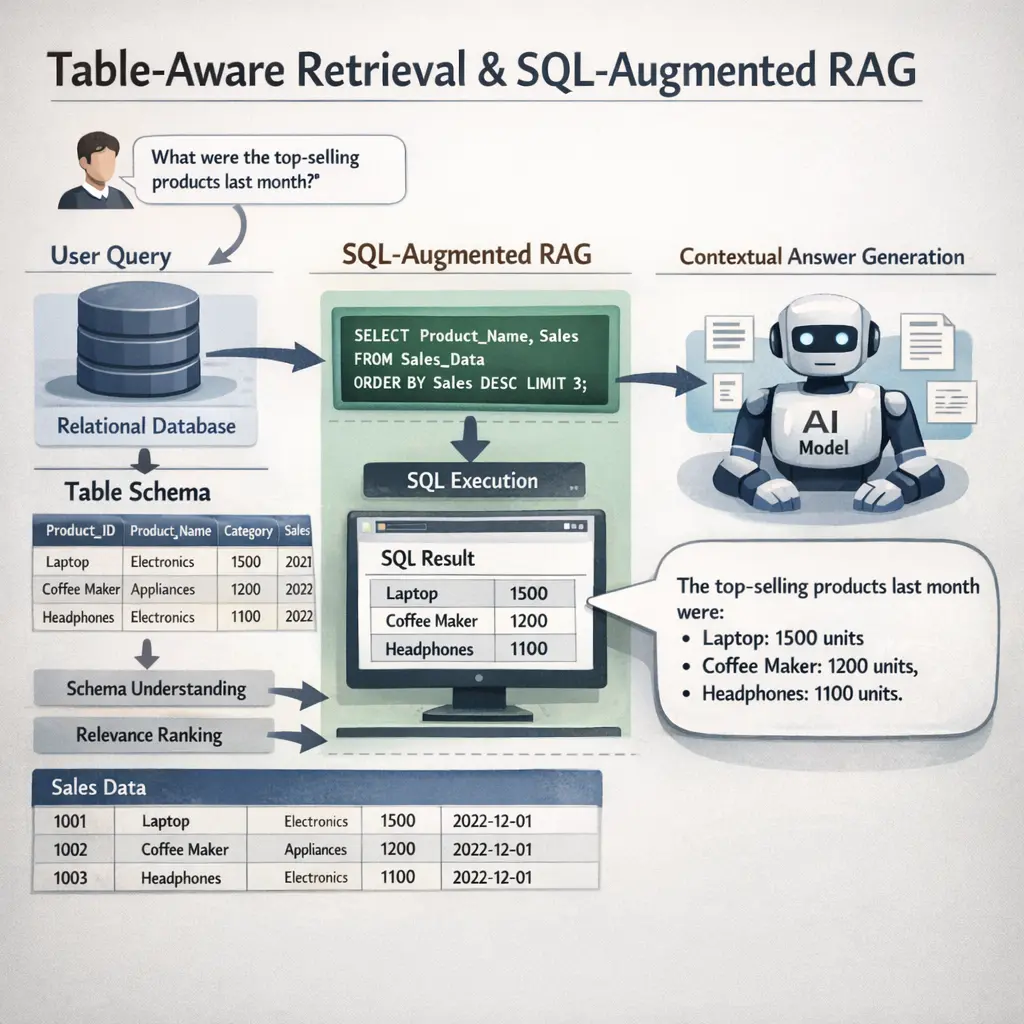
Table-Aware Retrieval and SQL-Augmented RAG refers to advanced AI techniques that enhance information retrieval and generation by leveraging structured data from tables and databases. Table-aware retrieval enables models to understand and extract relevant information from tabular data, while SQL-augmented RAG combines traditional retrieval-augmented generation with SQL queries. This approach allows AI systems to access, interpret, and generate responses using both unstructured text and structured database information, improving accuracy and relevance in data-driven tasks.
Table-Aware Retrieval and SQL-Augmented RAG
Table-Aware Retrieval and SQL-Augmented RAG refers to advanced AI techniques that enhance information retrieval and generation by leveraging structured data from tables and databases. Table-aware retrieval enables models to understand and extract relevant information from tabular data, while SQL-augmented RAG combines traditional retrieval-augmented generation with SQL queries. This approach allows AI systems to access, interpret, and generate responses using both unstructured text and structured database information, improving accuracy and relevance in data-driven tasks.
💡 Key Takeaways
- Understand what table-aware retrieval is and how tabular data improves answer accuracy
- Learn how SQL-augmented RAG combines retrieval with SQL queries to reason over structured data
- Explore practical workflows for building table-backed Q&A systems, including schema considerations and SQL generation
- Identify common challenges and best practices, such as schema drift, data freshness, and evaluating table-based results
❓ Frequently Asked Questions
What is table-aware retrieval?
Table-aware retrieval uses the structure and schema of tables (columns, relationships) to locate relevant data, not just plain text.
What is SQL-Augmented RAG?
SQL-Augmented RAG combines retrieval-augmented generation with SQL queries to fetch precise data from relational databases and ground the results.
How do these concepts work together?
Table-aware retrieval identifies relevant tables and schemas, constructs SQL queries to retrieve exact data, and uses that data to inform and ground the generated answers.
When should you use SQL-Augmented RAG?
When answers depend on exact table values, aggregates, or cross-table relationships from a database, ensuring data accuracy.