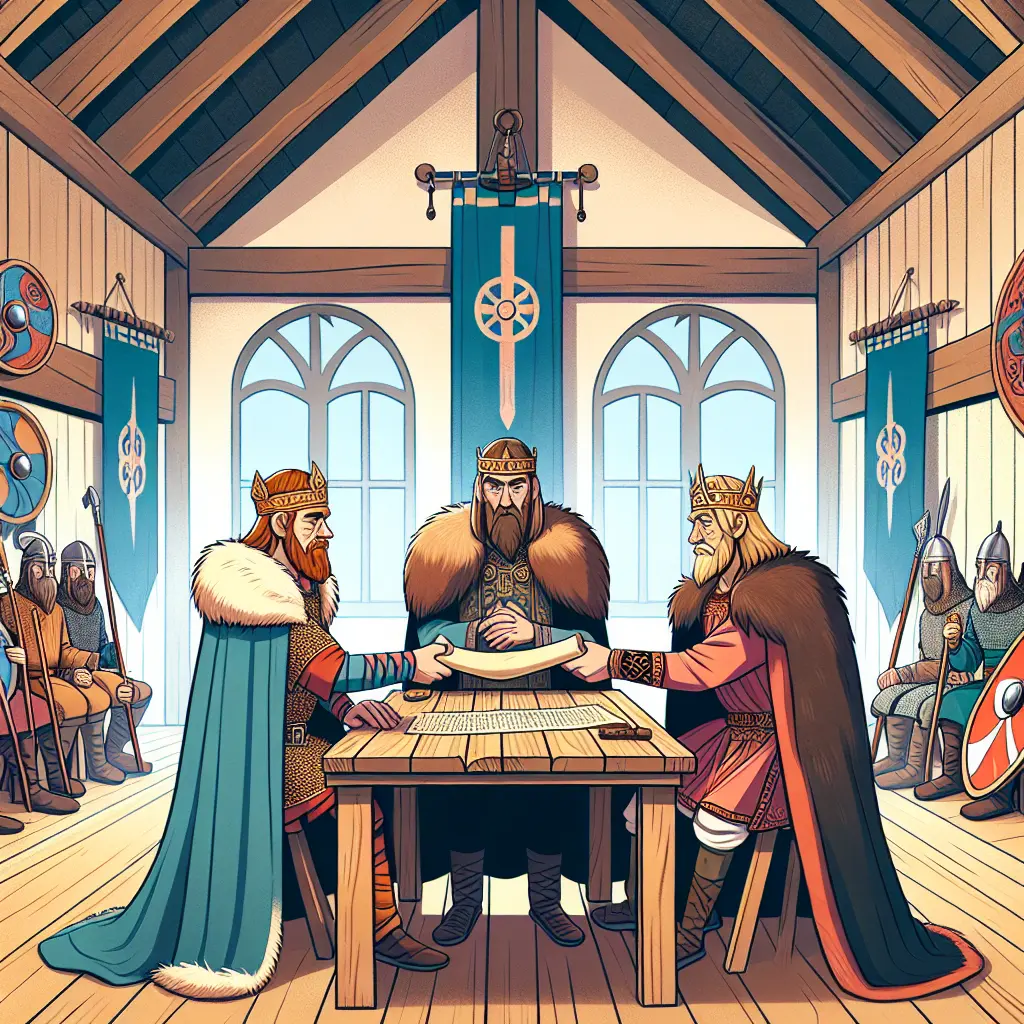
The Treaty of Wedmore refers to an agreement made in 878 AD between King Alfred the Great of Wessex and the Viking leader Guthrum after Alfred’s victory at the Battle of Edington. The treaty established boundaries between Anglo-Saxon and Viking-controlled territory, known as the Danelaw, and required Guthrum to convert to Christianity. This accord helped bring relative peace to England and marked a significant turning point in the struggle between the Anglo-Saxons and the Vikings.
The Treaty of Wedmore
The Treaty of Wedmore refers to an agreement made in 878 AD between King Alfred the Great of Wessex and the Viking leader Guthrum after Alfred’s victory at the Battle of Edington. The treaty established boundaries between Anglo-Saxon and Viking-controlled territory, known as the Danelaw, and required Guthrum to convert to Christianity. This accord helped bring relative peace to England and marked a significant turning point in the struggle between the Anglo-Saxons and the Vikings.
💡 Key Takeaways
- The Treaty of Wedmore, concluded after Alfred the Great's victory at Edington in 878, marked a shift from open warfare to negotiated peace with Viking leader Guthrum.
- It defined the Danelaw—the Viking-controlled region in eastern and northern England—creating a formal boundary with Anglo-Saxon Wessex.
- The agreement included religious and settlement terms, including Guthrum's baptism, signaling the Christianized, stabilized peace between the groups.
- The treaty laid foundations for later English governance, law, and defense, helping Alfred consolidate his kingdom and manage Viking relations.
❓ Frequently Asked Questions
What is the Treaty of Wedmore and when was it made?
An agreement in 878 between Alfred the Great of Wessex and Viking leader Guthrum, following the Battle of Edington, to establish peace and set regional boundaries.
Who were the main figures involved in the treaty?
King Alfred the Great and Guthrum, the Viking commander who had invaded Wessex.
What is the Danelaw?
The area of England under Danish control, whose boundaries were effectively defined by the treaty.
What was a key outcome of the treaty?
A formal peace and recognition of a boundary between Anglo-Saxon and Viking territories, with Guthrum’s conversion to Christianity as part of the settlement.