Advanced NDT (Non-Destructive Testing) techniques such as Infrared and Acoustic Emission are cutting-edge methods used to evaluate the integrity of materials and structures without causing damage. Infrared testing detects heat patterns and anomalies, revealing subsurface defects, while Acoustic Emission monitors sound waves generated by cracks or stress within materials. These techniques enhance safety, reliability, and early defect detection in scientific and industrial applications, ensuring optimal performance of critical components.
Advanced NDT Techniques (Infrared, Acoustic Emission)
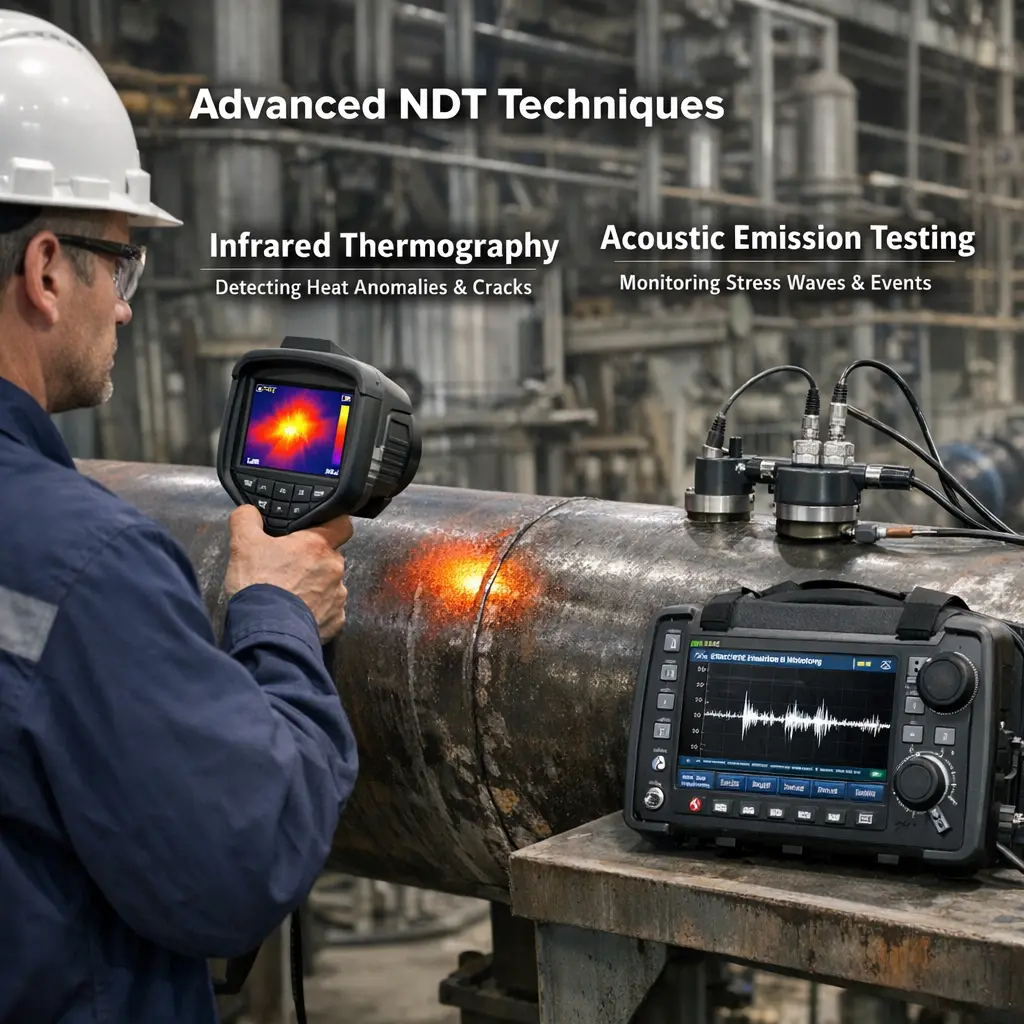
Advanced NDT (Non-Destructive Testing) techniques such as Infrared and Acoustic Emission are cutting-edge methods used to evaluate the integrity of materials and structures without causing damage. Infrared testing detects heat patterns and anomalies, revealing subsurface defects, while Acoustic Emission monitors sound waves generated by cracks or stress within materials. These techniques enhance safety, reliability, and early defect detection in scientific and industrial applications, ensuring optimal performance of critical components.
💡 Key Takeaways
- Understand the basic principles of infrared thermography for NDT and how heat patterns reveal subsurface defects.
- Learn how infrared data (thermograms) is captured, interpreted, and used to identify anomalies in materials.
- Understand the principles of acoustic emission (AE) testing, including how high-frequency stress waves indicate crack growth and material damage.
- Compare infrared thermography and acoustic emission: strengths, limitations, and the types of defects and scenarios each method is best suited for.
- Identify key equipment considerations (sensors, cameras, data acquisition) and basic interpretation techniques to distinguish true defects from noise.
❓ Frequently Asked Questions
What is infrared thermography (IR) in NDT?
IR thermography is a non-destructive technique that uses an infrared camera to map surface temperatures. Thermal patterns reveal subsurface defects, insulation faults, or electrical issues by showing how heat flows through a material.
How does acoustic emission (AE) testing work?
AE detects high-frequency stress waves produced by rapid changes in materials (e.g., crack growth). Surface sensors record events, and analysis of energy, amplitude, and timing helps locate and assess damage.
What are common applications of IR thermography in NDT?
Electrical inspections (switchgear, panels), insulation or coating defects, mechanical faults in bearings, and monitoring composites or structures for heat-related anomalies.
What is the difference between active and passive infrared thermography?
Active IR uses an external heat source to provoke a thermal response, while passive IR relies on existing heat in the object without applying additional heating.