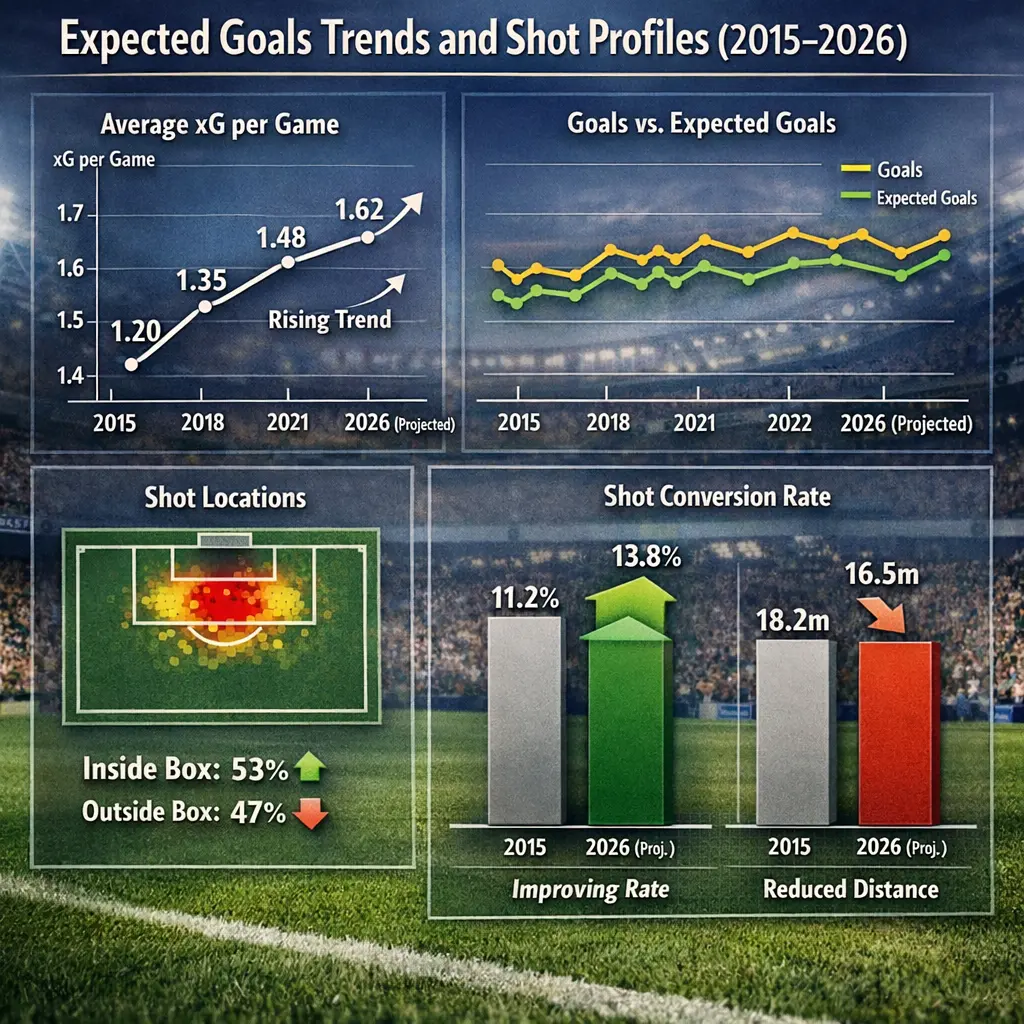
From 2015 to 2026, Manchester United’s expected goals (xG) trends reveal shifts in attacking efficiency and creativity. Early years showed reliance on individual brilliance, with fewer high-quality chances. As tactical approaches evolved, shot profiles diversified, reflecting more structured build-up play and an increased focus on creating higher xG opportunities. The period also highlights fluctuations in shot volume, location, and finishing, mirroring managerial changes and squad development throughout these seasons.
Expected Goals Trends and Shot Profiles (2015–2026)
From 2015 to 2026, Manchester United’s expected goals (xG) trends reveal shifts in attacking efficiency and creativity. Early years showed reliance on individual brilliance, with fewer high-quality chances. As tactical approaches evolved, shot profiles diversified, reflecting more structured build-up play and an increased focus on creating higher xG opportunities. The period also highlights fluctuations in shot volume, location, and finishing, mirroring managerial changes and squad development throughout these seasons.
💡 Key Takeaways
- Define expected goals (xG) and how shot quality informs scoring probability.
- Track xG trends from 2015–2026 to understand evolving tactics and scoring.
- Evaluate shot profiles—distance, angle, and type—and their influence on xG.
- Interpret league-wide shifts in xG and shot profiles to forecast future performance.
- Compare xG to actual goals to assess finishing efficiency and regression.
❓ Frequently Asked Questions
What is expected goals (xG) and why is it useful in this article?
xG is a probability score for each shot estimating its chance of scoring, based on factors like distance, angle, and shot type. It helps compare shot quality and identify trends from 2015–2026.
What does a 'shot profile' describe in this study?
A shot profile describes how teams take their shots: where and how far from goal, shot type (foot or head), whether it’s from open play or set-pieces, and whether it’s from inside vs outside the box.
What kinds of trends might appear in xG and shot profiles over 2015–2026?
Trends may include shifts toward higher-quality shots (closer to goal), changes in shot types, tactical adjustments, and improvements in data collection and modeling that affect xG accuracy.
How should you interpret differences between actual goals and xG in the quiz?
If goals exceed xG, finishing quality or luck contributed; if goals are below xG, finishing or defensive strength may have limited scoring. Consider sample size and context.