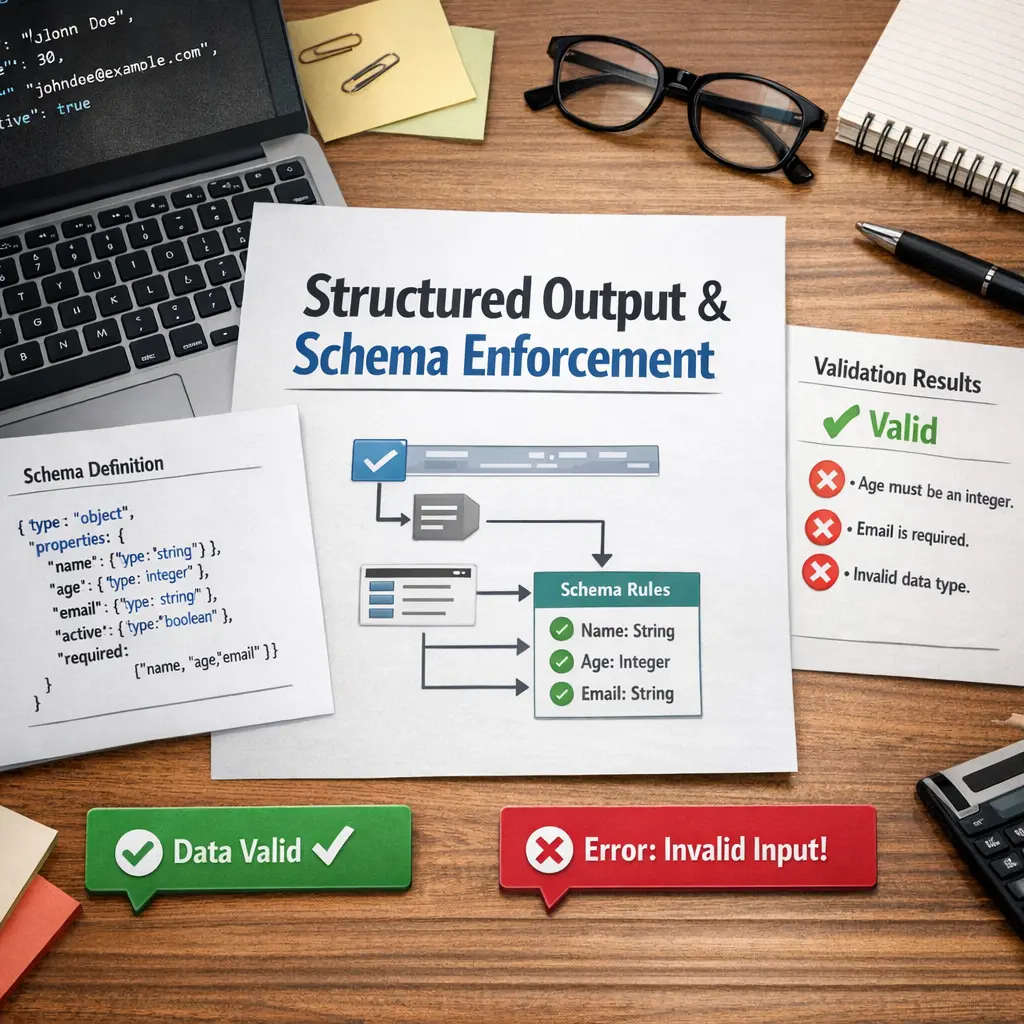
Structured Output & Schema Enforcement in agent architecture refers to designing intelligent systems that generate responses or actions in a predefined format, ensuring consistency and reliability. By enforcing a specific schema, agents adhere to strict data structures, making outputs predictable and machine-readable. This approach improves interoperability, facilitates downstream processing, and reduces errors, as agents are constrained to output only valid, expected information according to the established schema.
Structured Output & Schema Enforcement
Structured Output & Schema Enforcement in agent architecture refers to designing intelligent systems that generate responses or actions in a predefined format, ensuring consistency and reliability. By enforcing a specific schema, agents adhere to strict data structures, making outputs predictable and machine-readable. This approach improves interoperability, facilitates downstream processing, and reduces errors, as agents are constrained to output only valid, expected information according to the established schema.
💡 Key Takeaways
- Define what structured output means and why it matters for consistency and automation.
- Explain how schema enforcement validates data against a predefined structure and constraints.
- Introduce common schema formats (e.g., JSON Schema) and basic validation concepts.
- Apply best practices for designing quiz outputs that are easy to process and integrate with systems.
❓ Frequently Asked Questions
What is structured output?
Structured output is data organized in a defined, machine-readable format (like JSON or XML) with labeled fields that are easy to parse and validate.
What is a schema in data processing?
A schema is a blueprint that defines allowed fields, data types, formats, and constraints for data, acting as a contract for valid data.
How can you enforce a schema on JSON data?
Use a schema language like JSON Schema to declare required properties and types, then validate the data before use.
Why is schema enforcement important?
It ensures data quality, prevents processing errors, and enables predictable, interoperable handling across systems.