Transition Play: Defensive to Offensive Efficiency at Chelsea F.C. refers to the team’s ability to swiftly shift from defending to attacking. This involves regaining possession, quickly exploiting spaces left by the opposition, and launching rapid, coordinated attacks. Chelsea emphasizes structured defensive organization and immediate forward movement, utilizing pacey wingers and creative midfielders to maximize scoring opportunities during transitional moments, making them highly effective and dangerous on the counter-attack.
Transition Play: Defensive to Offensive Efficiency
Transition Play: Defensive to Offensive Efficiency at Chelsea F.C. refers to the team’s ability to swiftly shift from defending to attacking. This involves regaining possession, quickly exploiting spaces left by the opposition, and launching rapid, coordinated attacks. Chelsea emphasizes structured defensive organization and immediate forward movement, utilizing pacey wingers and creative midfielders to maximize scoring opportunities during transitional moments, making them highly effective and dangerous on the counter-attack.
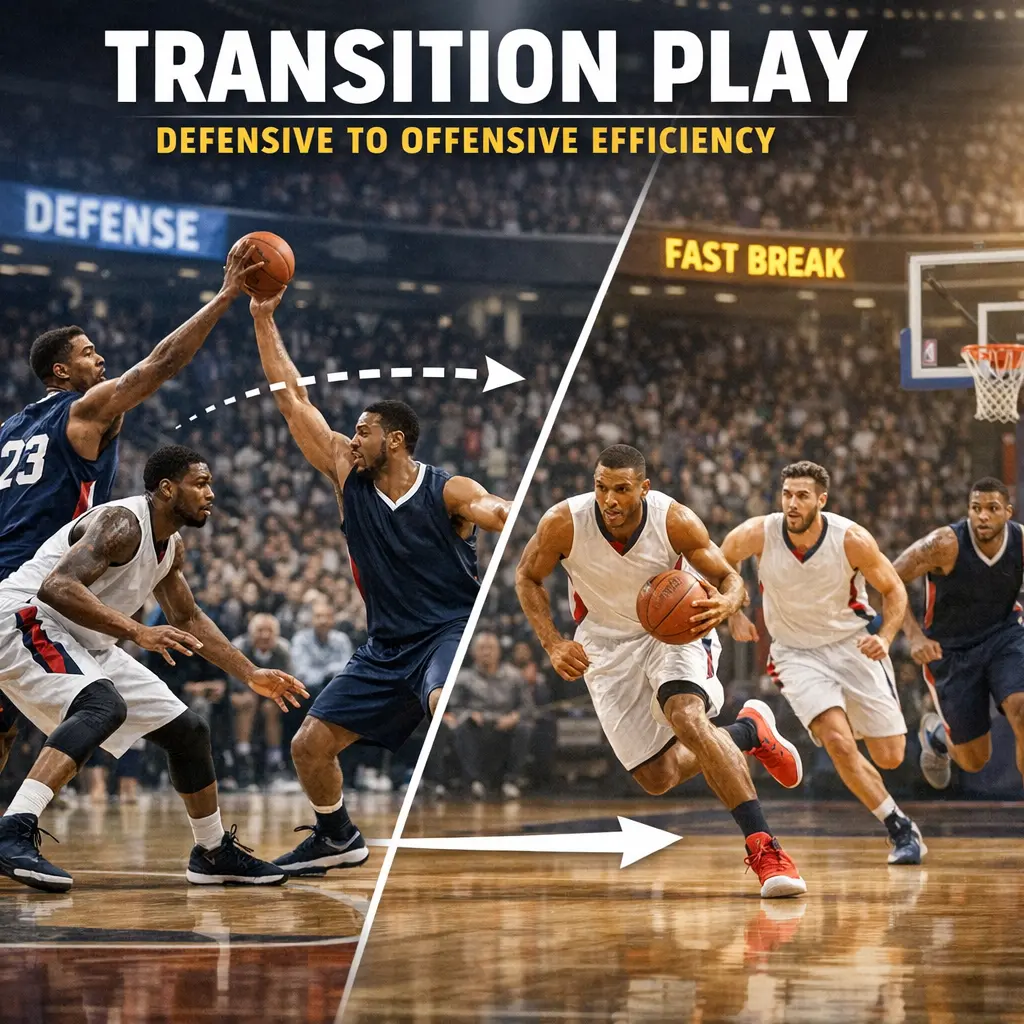
💡 Key Takeaways
- Understand how to convert defensive stops into efficient transition scoring
- Learn the key metrics for transition efficiency (e.g., transition points per possession, fast-break rate, turnover-driven breaks)
- Master outlet passing, sprinting into transition, and spacing to maximize fast-break opportunities
- Balance pace with smart shot selection to improve transition conversion and offensive efficiency
❓ Frequently Asked Questions
What is transition play and why is it important for efficiency?
Transition play is the fast sequence when a team moves from defense to offense after a stop or turnover; it often yields high scoring efficiency because defenses are not yet set.
How is defensive to offensive transition efficiency measured?
Usually by points scored per transition possession, i.e., how many points a team scores on quick breaks after a stop or turnover.
What factors influence transition efficiency?
Outlet speed, floor spacing, smart decision making on the break, and finishing at the rim; also how well the opponent protects the rim on fast breaks.
How can teams improve defensive to offensive transition efficiency?
Improve by practicing quick outlets, sprinting the floor, making smart reads on the break, protecting the ball, and finishing efficiently at the rim.