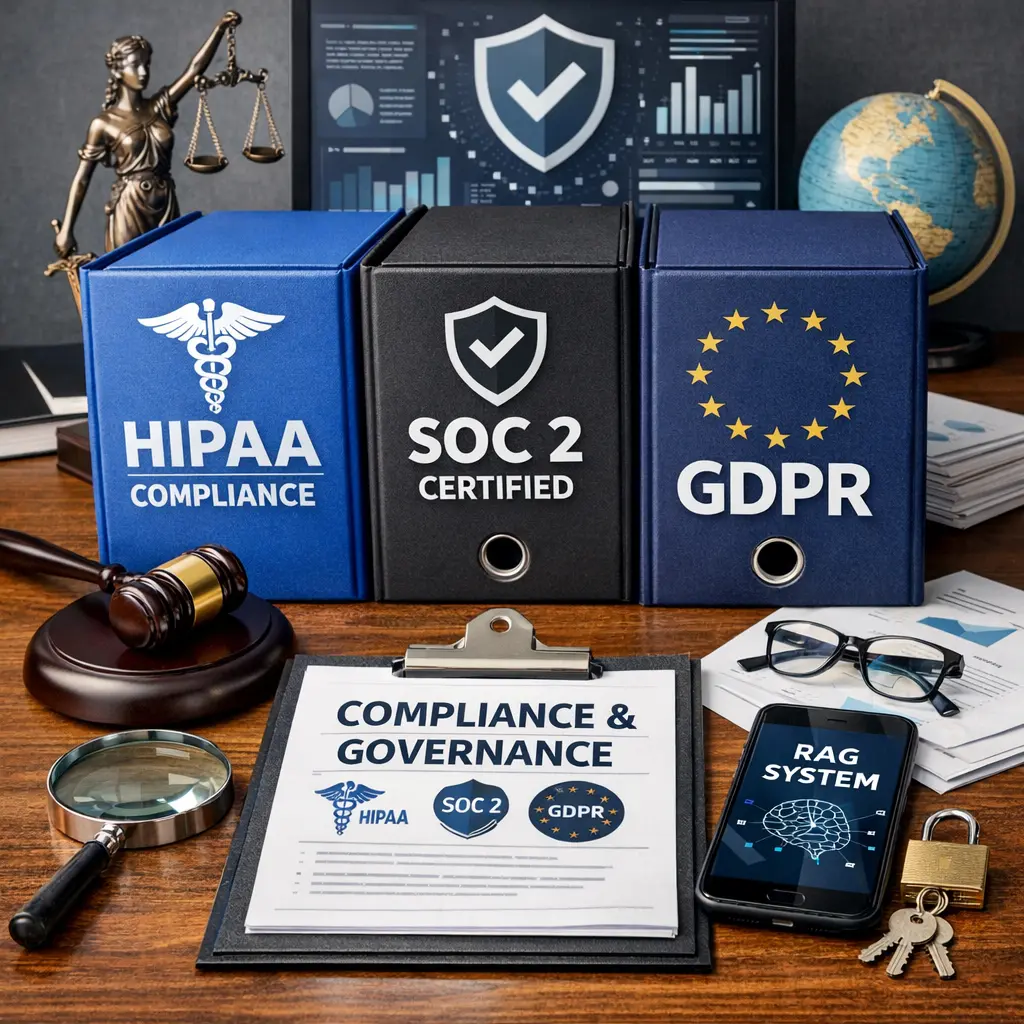
Compliance and governance for Retrieval-Augmented Generation (RAG) involve ensuring that data handling and processing adhere to regulations like HIPAA (health data privacy), SOC2 (service organization controls for security and privacy), and GDPR (EU data protection). RAG systems must implement safeguards to protect sensitive information, maintain audit trails, and enable data subject rights, ensuring that AI-generated outputs and data retrieval processes meet stringent legal and ethical standards.
Compliance and Governance: HIPAA, SOC2, and GDPR for RAG
Compliance and governance for Retrieval-Augmented Generation (RAG) involve ensuring that data handling and processing adhere to regulations like HIPAA (health data privacy), SOC2 (service organization controls for security and privacy), and GDPR (EU data protection). RAG systems must implement safeguards to protect sensitive information, maintain audit trails, and enable data subject rights, ensuring that AI-generated outputs and data retrieval processes meet stringent legal and ethical standards.
💡 Key Takeaways
- Understand how HIPAA, GDPR, and SOC 2 apply to RAG data handling and what data qualifies as regulated or sensitive.
- Implement safeguards across RAG pipelines—access controls, encryption, authentication, and audit trails—to meet HIPAA Security Rule, SOC 2 criteria, and GDPR principles.
- Design RAG workflows that minimize exposure of restricted data, support data subject rights, retention, and breach notification requirements.
- Evaluate vendors, data transfers, and governance controls (BAA/DPA, data residency, risk assessments) to ensure compliant RAG deployments.
❓ Frequently Asked Questions
What is HIPAA and when does it apply to RAG systems?
HIPAA protects health information (PHI). It applies to covered entities and business associates that handle PHI. If a RAG system processes PHI or PHI-based data, you must comply with HIPAA (Privacy and Security Rules, minimum necessary, breach notification). Use business associate agreements (BAAs) with vendors and implement safeguards like access controls and encryption.
What is SOC 2 and why is it relevant to RAG systems?
SOC 2 is a framework for evaluating service organizations’ controls against the Trust Services Criteria (security, availability, processing integrity, confidentiality, privacy). A Type II report shows controls are effective over time. For a RAG system, SOC 2 demonstrates governance and security around data handling, access, and uptime, aiding trust with customers and auditors.
How does GDPR impact RAG systems handling EU personal data?
GDPR governs processing of personal data of individuals in the EU. If your RAG system processes such data, you must meet requirements like lawful basis, purpose limitation, data minimization, data subject rights, transparency, security measures, and breach notification within 72 hours. Consider roles (controller vs processor) and ensure DPAs where processors are involved; address cross-border data transfers appropriately.
What practical steps can you take to align HIPAA, SOC2, and GDPR for a RAG workflow?
Classify data (PHI, personal data, sensitive info); minimize data used in RAG (data masking). Enforce encryption at rest and in transit; apply least-privilege access (RBAC); maintain detailed audit logs; establish DPAs/BAAs; map data flows and perform DPIAs where needed; implement incident response procedures and regular security/privacy training and audits.